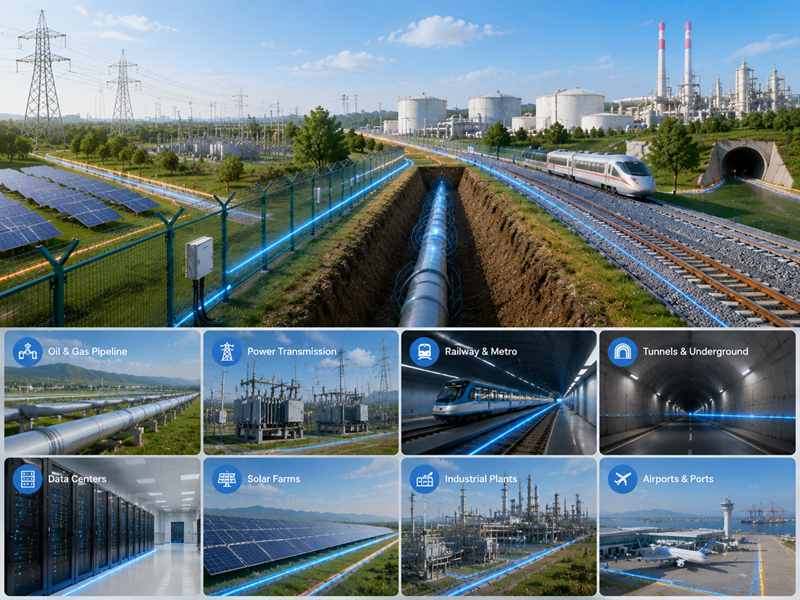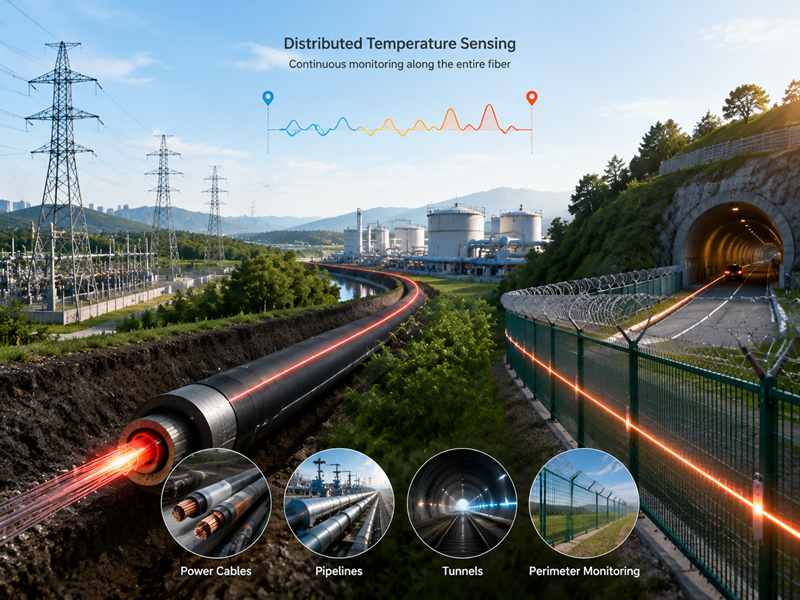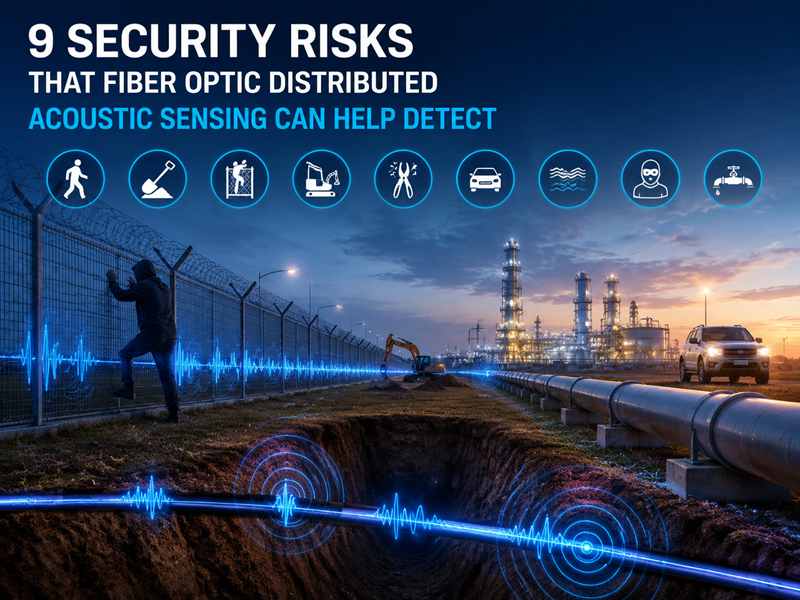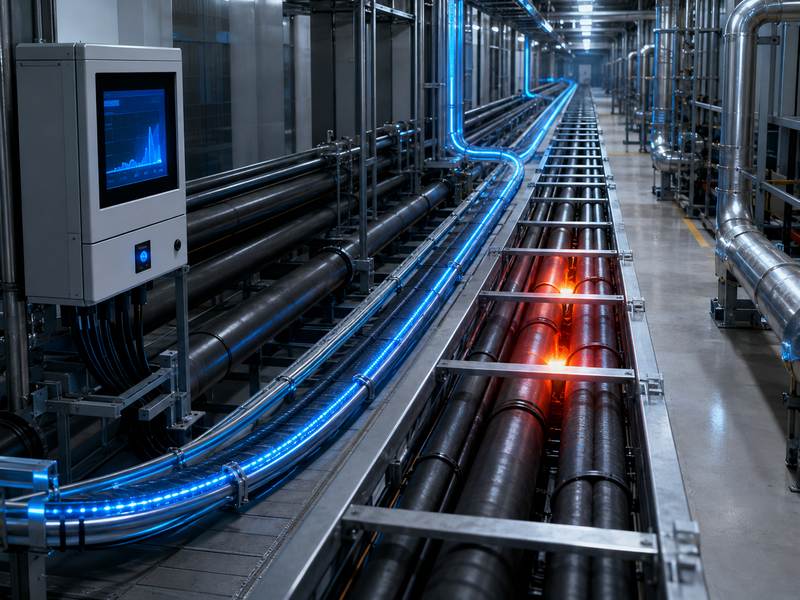
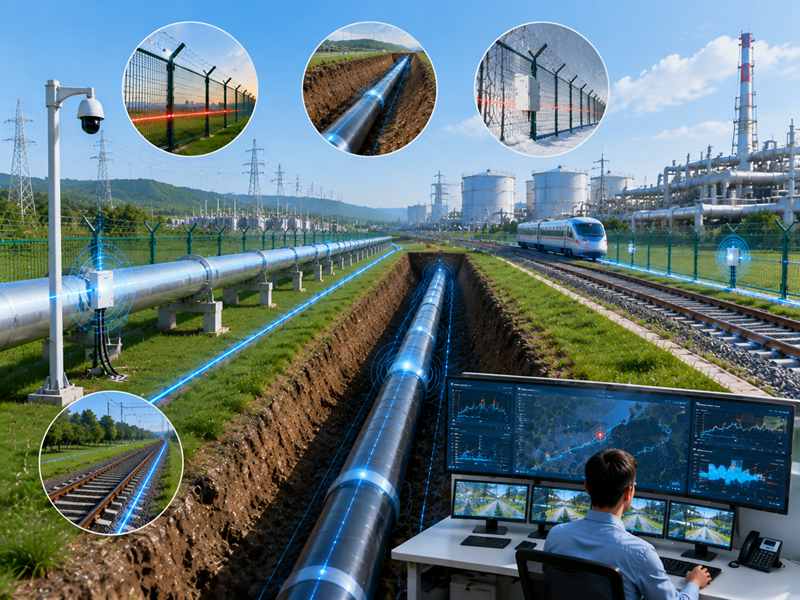
Large-scale infrastructure featuring extended boundaries, underground spaces and remote regions faces risks arising from security blind zones, which necessitates uninterrupted safety protection.
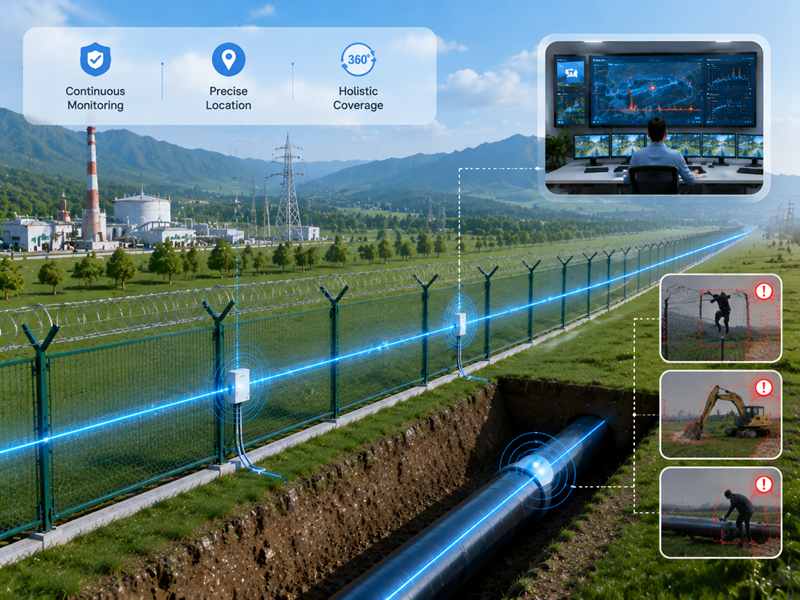
Conventional monitoring systems are prone to monitoring gaps. In contrast, DAS technology enables seamless fiber sensing, precise spatial positioning and holistic security coverage.
Extend Perimeter Coverage by Deploying Distributed Fiber Sensing
Replacing point-based monitoring with continuous DAS sensing expands coverage and reduces security gaps across large perimeter areas.
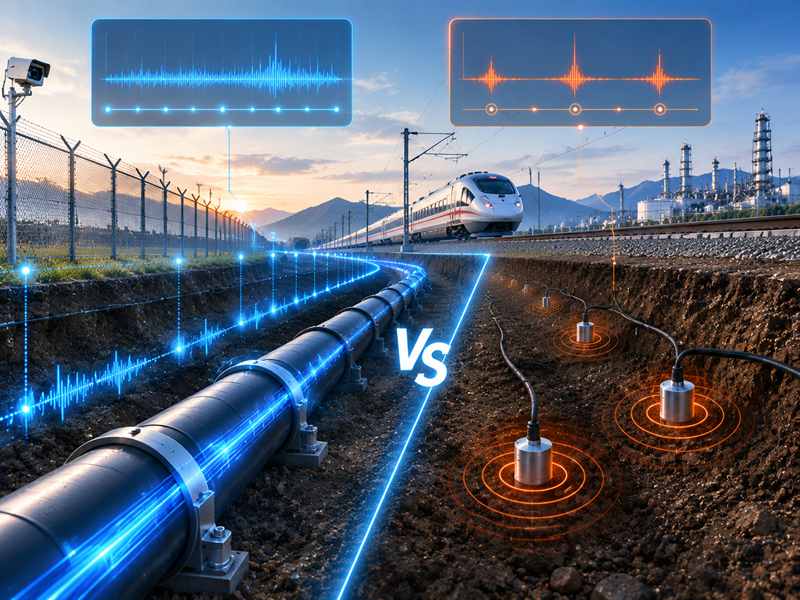
Using optical fiber as a distributed sensor enables continuous vibration detection, helping protect areas beyond traditional monitoring limitations.
This deployment method is especially suitable for:
- Industrial factory boundaries
- Railway corridors
- Pipeline routes
- Energy transmission infrastructure
- Large restricted zones
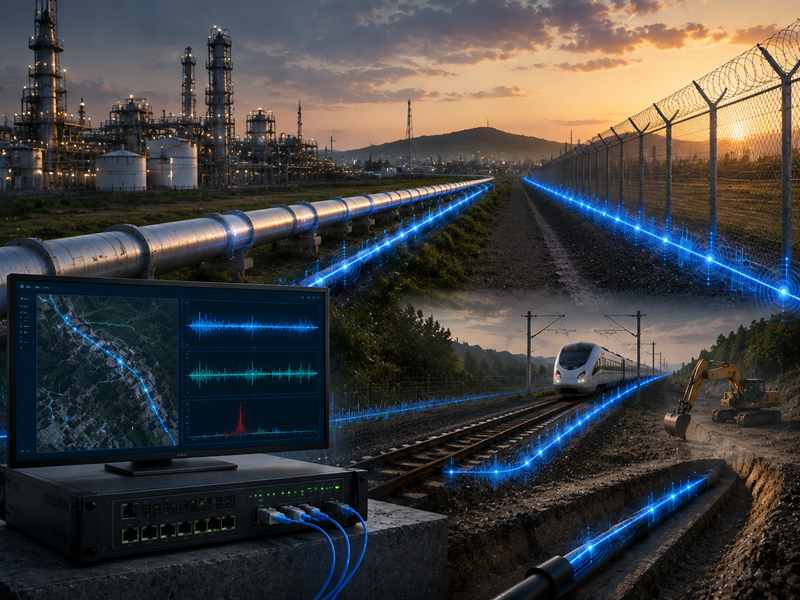
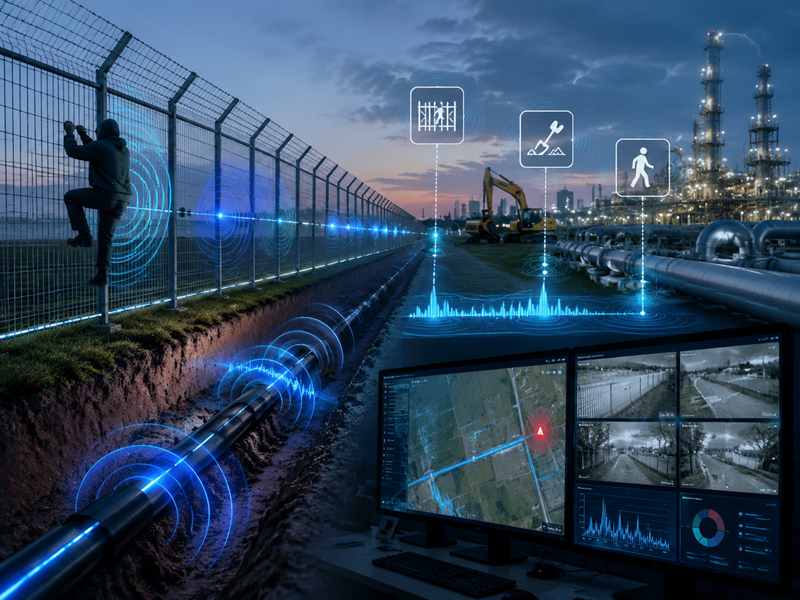
When abnormal vibration occurs, such as climbing, cutting, digging, or unauthorized movement, the DAS system analyzes signal changes and identifies potential intrusion activities.
| Security Method | Detection Coverage | Limitation |
| CCTV Monitoring | Fixed visual areas | Cannot cover hidden or distant zones |
| Point Intrusion Sensors | Specific detection points | Coverage gaps between devices |
| DAS Fiber Sensing | Continuous monitoring route | Suitable for large linear areas |
In large-scale projects, extending monitoring coverage often brings greater benefits than simply installing extra detectors. DAS forms a persistent monitoring layer and avoids coverage gaps stemming from long distances and varied terrain.
Eliminate Hidden Area Risks Through Flexible Fiber Installation Methods
Various types of security blind zones call for differentiated deployment strategies. Uniform installation layouts are not applicable to factory perimeters, underground pipelines and railway alignments.
By adjusting fiber cabling schemes in accordance with monitored surroundings, DAS technology mitigates potential risks within concealed regions.
Deploy Buried Fiber Cable to Protect Underground Blind Spots
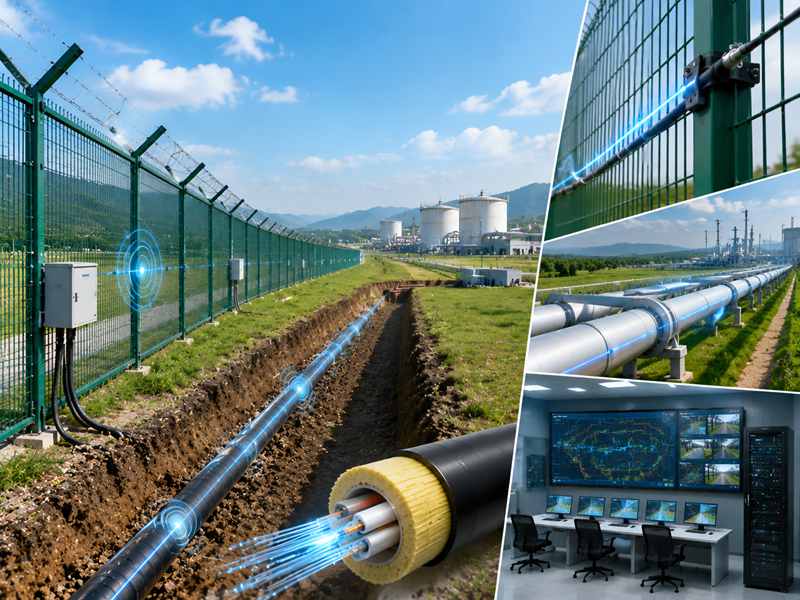
Monitoring underground assets remains difficult, owing to the inability of standard visual systems to observe underground activities directly. Fiber-optic cables buried underground are adopted in buried cable intrusion detection systems to sense vibration changes generated by:
- Unauthorized excavation
- Digging activities
- Cable damage attempts
- External interference
This approach is suitable for:
- Power cable corridors
- Communication cable routes
- Pipeline protection
- Restricted underground areas
Install Fiber Detection on Fences to Protect Boundary Weak Points
Industrial sites usually rely on physical fences as their initial line of defense. Still, failure to rapidly identify climbing, cutting or forced trespassing activities will render fences vulnerable to security breaches.
Fence intrusion detection systems combine fiber sensing technology with perimeter infrastructures. The system senses vibration fluctuations generated by:
- Fence climbing
- Metal cutting
- Structural impact
- Forced entry attempts
Typical applications include:
- Power substations
- Manufacturing plants
- Warehouses
- Security-restricted facilities
Apply Linear Fiber Monitoring for Long-Distance Infrastructure
Some assets extend across several kilometers and cannot rely on traditional fixed-point monitoring.
Fiber optic intrusion detection systems based on DAS technology are suitable for:
- Railway boundaries
- Oil and gas pipelines
- Energy corridors
- Large outdoor facilities
| Installation Method | Blind Spot Addressed | Typical Application |
| Buried Fiber Detection | Underground hidden areas | Pipeline, cable protection |
| Fence Fiber Detection | Boundary weak points | Factory perimeter |
| Linear Fiber Monitoring | Remote long-distance areas | Railway, energy infrastructure |
The adoption of suitable installation methods significantly impacts DAS detection capability. Carefully arranged fiber paths deliver continuous protection to critical regions.
Improve Event Location Accuracy to Reduce Response Blind Spots
Security blind spots include unknown alarm locations, causing longer investigations and slower responses during intrusion events.
DAS technology improves event positioning by analyzing fiber vibrations and identifying abnormal activity locations accurately.
This allows operators to quickly identify:
- The affected perimeter section
- The distance from the control point
- The potential risk area
For example, in a pipeline protection project, a DAS system can help locate the section where excavation vibration appears. Security personnel can inspect the specific area instead of checking the entire pipeline route.
| Security Process | Traditional Method | DAS-Based Method |
| Detect Event | Alarm from fixed sensor | Distributed vibration analysis |
| Find Location | Manual inspection | Fiber-based event positioning |
| Response Action | Wider search area | Targeted investigation |
Reduce Detection Gaps Through Multi-Layer Security Integration
Since individual equipment can only satisfy specific security needs, diverse technologies must be integrated to construct a full-function security system.
DAS is capable of large-scale perimeter sensing. Meanwhile, CCTV, VMS and access control platforms enhance incident confirmation and accelerate response procedures.
A typical workflow includes:
Step 1: DAS detects abnormal vibration.
Step 2: The system identifies the event location.
Step 3: CCTV automatically displays the related area.
Step 4: Security personnel verify and respond.
| Integrated Technology | Security Function | Blind Spot Reduction Effect |
| DAS | Long-distance intrusion detection | Covers large unattended areas |
| CCTV | Visual confirmation | Reduces uncertainty after alarms |
| Laser Beam Detection | Entrance protection | Covers fixed access points |
| Access Control | Identity verification | Controls authorized entry |
For example, a laser beam intrusion detection system may protect gates and entrances, while DAS protects the wider perimeter area. Combining both technologies prevents gaps between different security zones.
Customize DAS Deployment Based on Site Risk Distribution
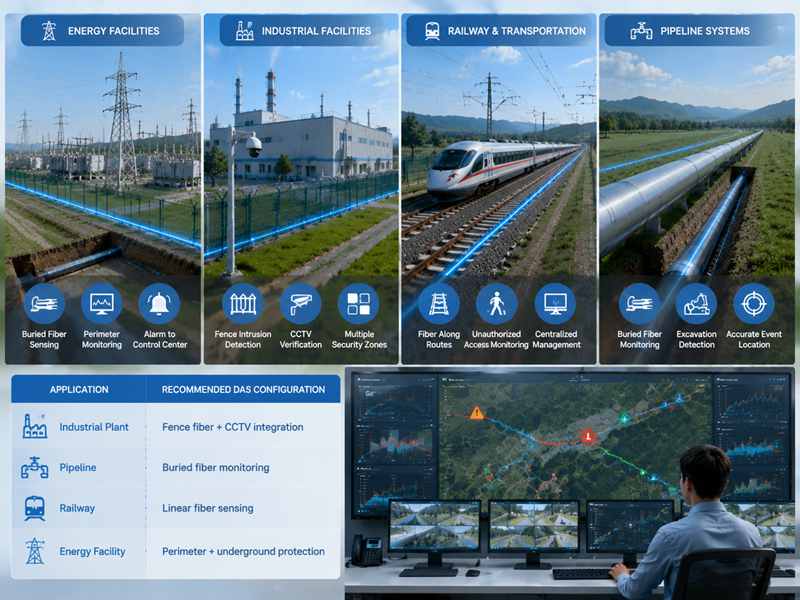
Facilities are subject to distinct risk patterns. Standard security designs cannot guarantee optimal protection as critical regions, installation environments and operational requirements differ from site to site.
Customized DAS systems need to be planned matching site structures and security objectives.
Energy Facilities
Vast outdoor regions and isolated equipment areas are typical components of energy infrastructure.
Recommended measures:
- Deploy buried fiber sensing around cable routes
- Monitor remote perimeter sections continuously
- Integrate alarms with control centers
Industrial Facilities
Protection is required for manufacturing zones, storage areas and outer boundaries within industrial premises.
Recommended measures:
- Combine fence intrusion detection with DAS
- Add CCTV verification
- Create multiple security zones
Railway and Transportation Infrastructure
Extensive linear infrastructures are distributed along railway routes and require persistent surveillance.
Recommended measures:
- Deploy fiber along restricted routes
- Monitor unauthorized access points
- Integrate with centralized management platforms
Pipeline Systems
Many pipeline routes stretch across isolated regions, where routine manual patrols encounter substantial obstacles.
Recommended measures:
- Install buried fiber monitoring
- Detect excavation activities
- Provide accurate event location
| Application | Recommended DAS Configuration |
| Industrial Plant | Fence fiber + CCTV integration |
| Pipeline | Buried fiber monitoring |
| Railway | Linear fiber sensing |
| Energy Facility | Perimeter + underground protection |
A customized design ensures that DAS technology is applied where it creates the highest security value instead of simply increasing equipment quantity.
Build a Complete Perimeter Protection Architecture with DAS
Single detection devices are insufficient to remove security blind spots. Establishing successive defensive layers delivers optimal protective outcomes.
A full-scale perimeter security system can incorporate the following components:
Physical Protection Layer
Fences, barriers, and controlled access points establish the first security boundary, preventing unauthorized entry while creating a basic protection structure for critical facilities and restricted areas.
Detection Layer
Vibration fluctuations are persistently monitored by DAS, fiber-optic intrusion detection equipment and perimeter sensors. These systems recognise unusual behaviours and minimise monitoring gaps over wide safeguarded regions.
Verification Layer
Once alarms are activated, visual evidence can be obtained via CCTV equipment and monitoring platforms. Operators are thereby able to evaluate incidents, authenticate threats and raise the accuracy level of security responses.
Response Layer
Security responses are coordinated by alarm systems and command centers. Such collaboration facilitates rapid decision-making, unified management, and efficient handling of suspected intrusion incidents.
Remedying security blind gaps relies on uninterrupted detection, expanded monitoring scope and the convergence of multiple security technologies into one coordinated platform.
DAS leverages fiber-optic cables to build distributed sensing networks. Integrated with different perimeter detectors, it delivers reliable protection for large critical infrastructure.