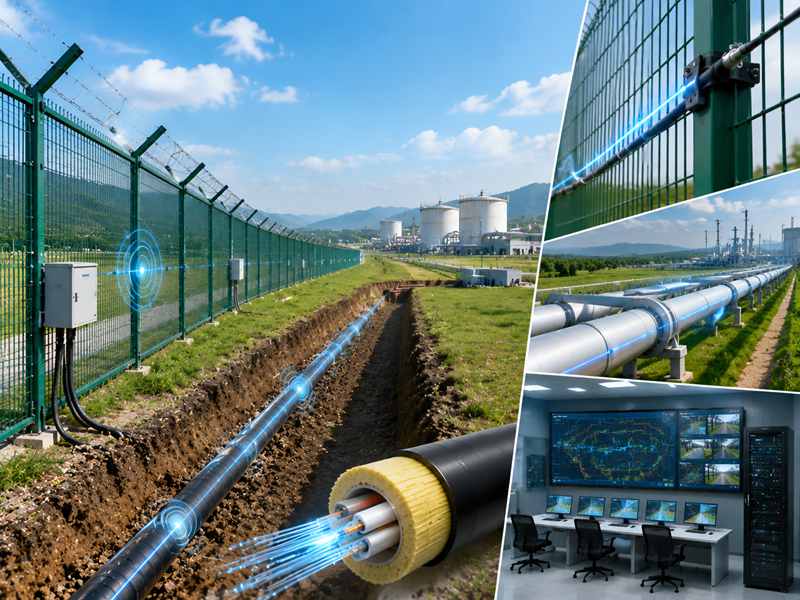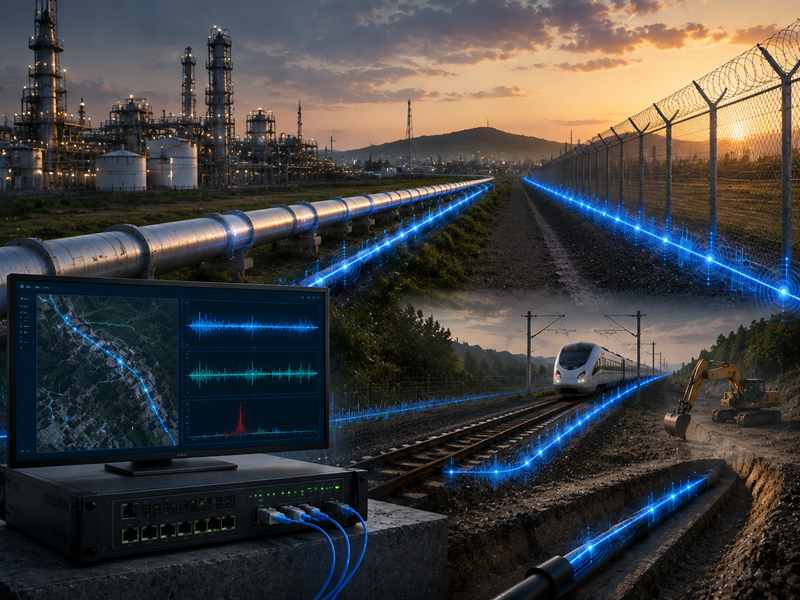
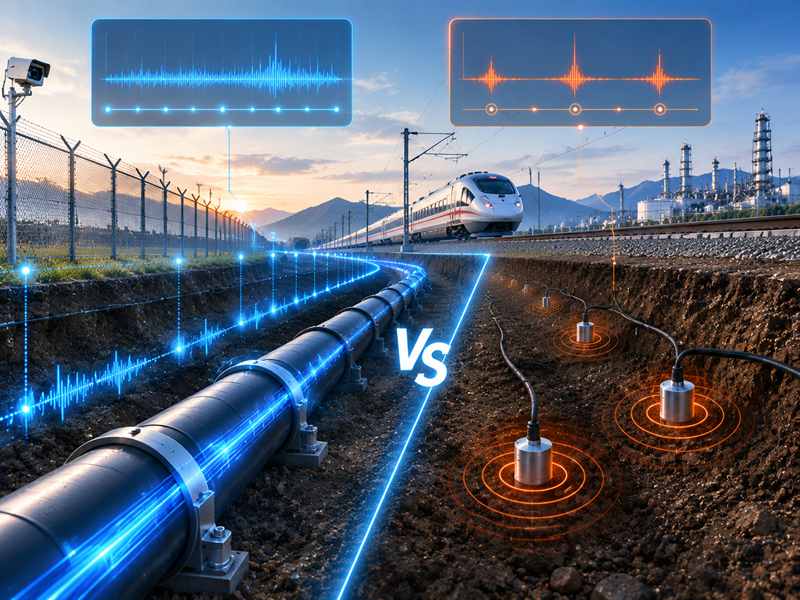
Geotechnical monitoring systems are widely deployed in civil infrastructure, energy facilities and security constructions. DAS realizes distributed sensing via optical fiber, while seismic transducers merely accomplish discrete vibration measurement.
Engineering personnel conduct comprehensive comparisons of monitoring span, field installation constraints, detection resolution and interconnection requirements. DAS features flexible expandability for pipeline corridors, railway tracks and large-scale perimeter surveillance.
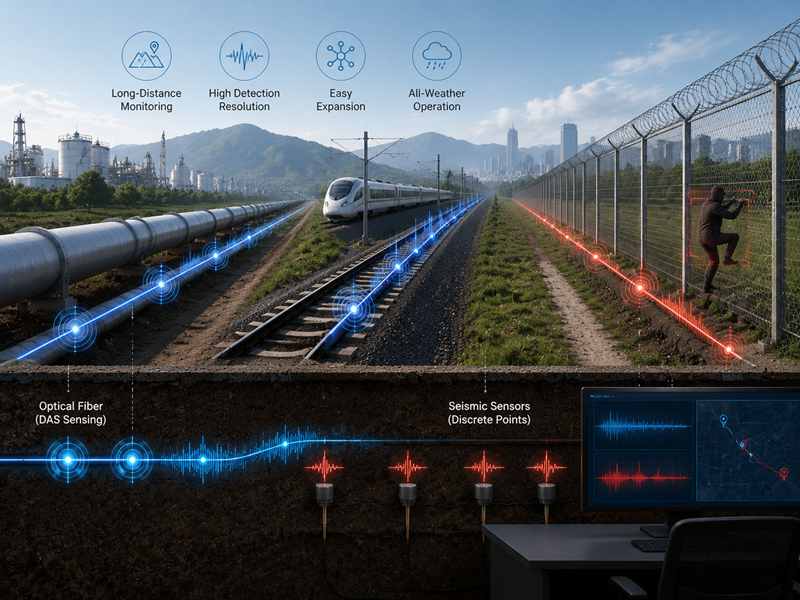
DAS vs. Seismic Sensors: Key Distinctions
| Comparison Item | DAS | Seismic Sensors |
| Detection Method | Fiber-based vibration sensing | Point vibration sensing |
| Monitoring Range | Kilometer-level continuous monitoring | Limited sensor coverage |
| Installation | Optical fiber deployment | Multiple sensor points |
| Expansion | Extend fiber routes | Add more sensors |
| Applications | Pipeline, railway, perimeter | Local vibration monitoring |
They differ greatly in sensing frameworks: seismic sensors collect single-point vibration data, yet DAS captures signals over the full fiber length.
DAS minimizes on-site hardware through fiber distributed sensing, ideal for long-distance projects requiring full continuous coverage.
Working Mechanism of DAS Technology in Geotechnical Monitoring
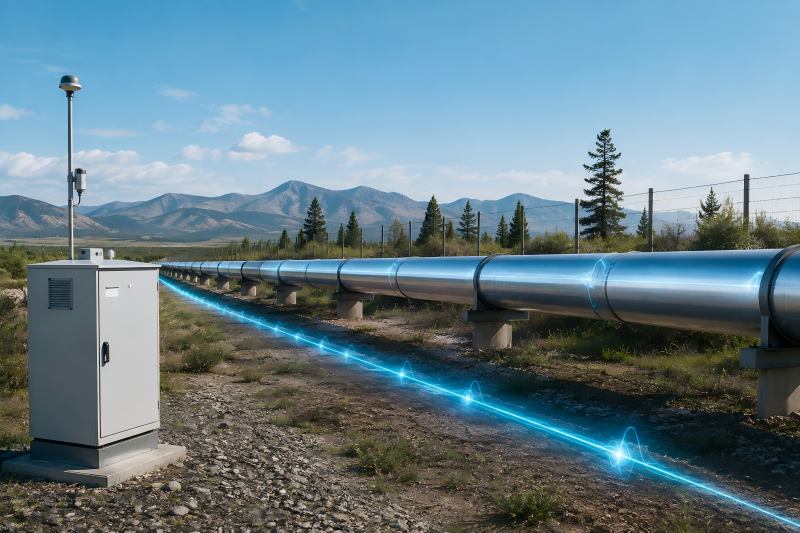
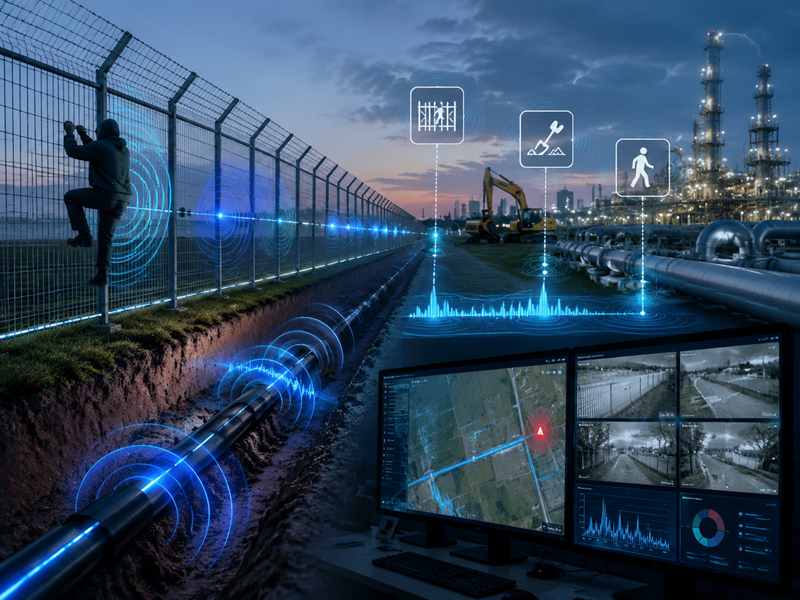
A laser signal is transmitted through the fiber, and changes in reflected light caused by external vibration are analyzed by the sensing unit.
When external activities create ground vibration, such as footsteps, digging equipment, vehicles, or mechanical operation, the vibration changes the optical characteristics of the fiber.
The DAS analyzer processes these signals and determines:
- vibration location
- signal intensity
- movement pattern
- event classification
- alarm priority
In practical applications, DAS is often installed with buried fiber cables, communication lines, or existing infrastructure routes.
How Seismic Detectors Realize Ground Vibration Monitoring?
Ground vibrational signals are acquired by seismic sensors equipped with mechanical-electrical sensing units. The physical displacement induced by wave transmission in strata or constructions is converted into electrical signals.
These systems are commonly installed in:
- restricted areas
- construction monitoring zones
- geological observation points
- local security boundaries
- equipment foundations
A typical seismic monitoring system requires multiple sensing units to achieve wider coverage. Seismic sensors perform excellently if monitoring points are fixed and clearly designated in advance.
Installation Comparison
| Installation Factor | Distributed Acoustic Sensing | Seismic Sensors |
| Field Devices | Mainly sensing unit and optical fiber | Multiple sensor nodes |
| Power Requirement | Fiber sensing cable itself is passive | Each sensor requires power supply or battery |
| Cable Deployment | Continuous fiber route | Separate cable connections for sensors |
| Maintenance Access | Centralized equipment maintenance | Multiple field inspection points |
| Suitable Environment | Long-distance and harsh environments | Local monitoring areas |
Remote sites like pipelines, borders, railways and underground passageways require fewer on-site devices for practical engineering deployment. DAS using buried fiber cables can track underground movements continuously, without installing electronic monitoring units all along the path.
It is especially valuable in areas where:
- power supply is limited
- weather conditions are severe
- maintenance access is difficult
- monitoring distance is extensive
Detection Capability Comparison
| Detection Scenario | Distributed Acoustic Sensing | Seismic Sensors |
| Footstep Detection | Suitable for continuous route monitoring | Suitable near individual detection zones |
| Excavation Activity | Detects vibration characteristics along fiber | Requires sensors near activity location |
| Vehicle Movement | Can identify moving vibration sources | Detects vibration near sensor points |
| Underground Intrusion | Suitable for buried perimeter protection | Depends on sensor distribution |
| Long Boundary Monitoring | Strong advantage due to distributed sensing | Requires many sensor units |
DAS excels in scenarios where potential abnormal events cannot be pinpointed beforehand. Take multi-kilometer solar farm boundaries as an example; trespassing may occur anywhere. Distributed fiber monitoring delivers full-range coverage instead of limited fixed sensing spots.
Application Comparison
Pipeline Ground Monitoring
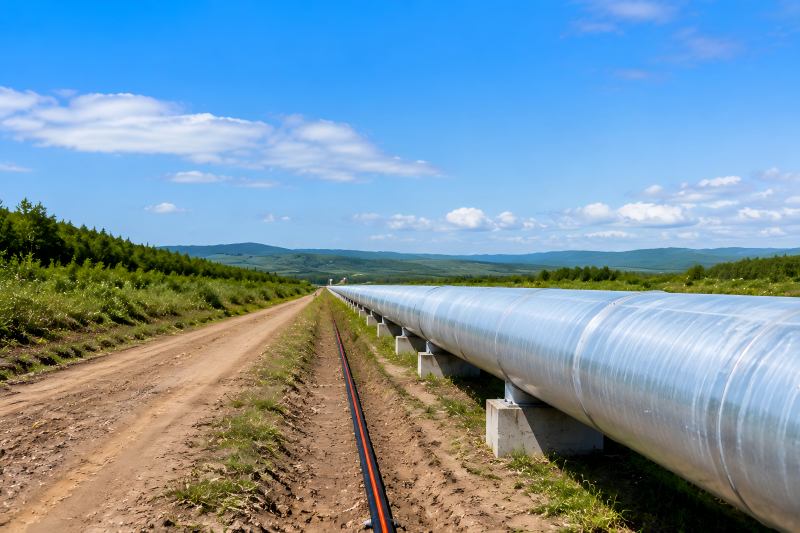
Most pipelines traverse inaccessible remote regions. Unauthorized digging, mechanical collisions and outside interference all pose severe safety hazards. Buried fiber-based DAS tracks vibration variations across the entire pipeline alignment and issues early alerts for nearby destructive operations.
| Application | Recommended Monitoring Approach |
| Long-distance oil and gas pipeline | DAS with fiber sensing cable |
| Short pipeline section | Seismic sensor network |
| Pipeline crossing area | Hybrid monitoring solution |
| Remote pipeline corridor | DAS-based centralized monitoring |
Railway Ground Monitoring
Rail transit facilities demand uninterrupted surveillance covering tracks, tunnels and restricted regions. DAS is capable of distinguishing anomalous vibration waveforms triggered by the following factors:
- unauthorized access
- track-side intrusion
- excavation near railway lines
- abnormal ground activity
Railway operators attach equal importance to threat identification and false alarm suppression. Signal classification and algorithm tuning differentiate regular train vibration from anomalous incidents.
Perimeter and Border Ground Monitoring
Large perimeter areas face challenges including:
- long monitoring distances
- difficult terrain
- limited patrol coverage
- blind spots
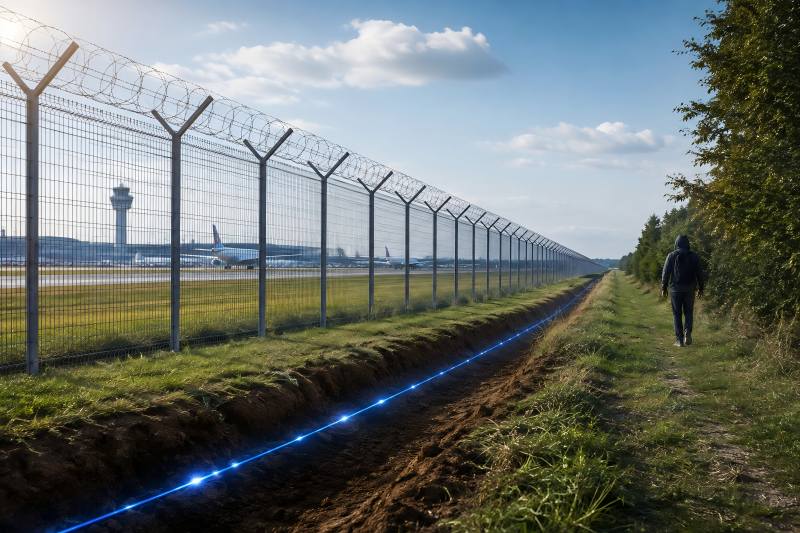
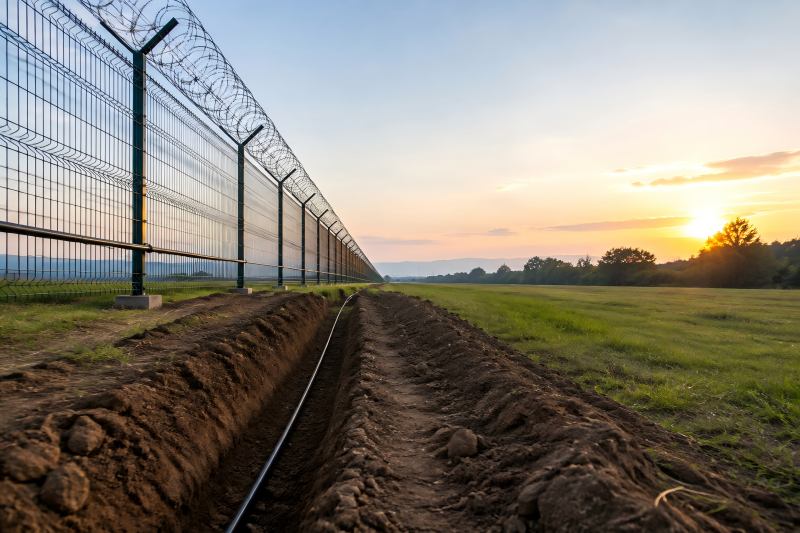
DAS is compatible with fiber-optic perimeter intrusion detection systems to deliver uninterrupted boundary surveillance. For projects needing tailored layouts, bespoke buried fiber intrusion detection systems integrate fiber sensing, alarm control and monitoring software adapted to on-site environments.
Operating Cost Comparison
Industrial engineering assessments cover equipment expenditure as well as maintenance demands, replacement cycles and scalable expansion performance. Though DAS entails greater upfront capital outlay, it cuts on-site hardware quantities and long-term upkeep costs versus seismic sensor arrays.
For large infrastructure projects, the cost evaluation should focus on monitoring efficiency rather than only equipment price.
Environmental Adaptability
| Environmental Condition | DAS Performance | Seismic Sensor Performance |
| Remote Outdoor Areas | Strong suitability due to passive fiber sensing | Requires sensor maintenance access |
| Electromagnetic Interference | Fiber is naturally resistant | Electronic sensors may require protection |
| Harsh Weather | Suitable with proper cable protection | Sensor housing protection required |
| Underground Installation | Effective with buried fiber routes | Requires planned sensor locations |
| Large Temperature Variation | Fiber-based sensing remains stable | Sensor components may require compensation |
Signal Analysis Capability
It is necessary for ground monitoring facilities to classify diverse vibrational waveforms instead of basic motion detection. Continuous full-length fiber signal analysis supported by DAS enhances the accuracy of event classification and spatial localization.
Key Signal Analysis Capabilities:
- Continuous Vibration Monitoring
Detects vibration changes across long-distance fiber routes without relying on multiple sensing points.
- Multi-Point Waveform Analysis
Analyzes vibration frequency, intensity, and waveform characteristics to classify different activities.
- Real-Time Event Classification
Helps distinguish between normal movement, vehicle vibration, construction activities, and unauthorized intrusion.
- Accurate Event Localization
Calculates alarm positions based on fiber distance, allowing operators to quickly identify the affected area.
- Large-Area Monitoring Capability
Supports continuous protection for pipelines, railways, buried cables, and extensive perimeter zones.
DAS systems analyze vibration patterns along the fiber route, allowing operators to determine not only whether an event occurs but also its exact location.
For buried cable protection projects, this capability helps security teams identify whether an alarm occurs near the beginning, middle, or end of a monitored route, improving response efficiency and reducing unnecessary inspections.
DAS and Seismic Sensors System Integration
| Integration Function | DAS System | Seismic Sensor System |
| CCTV Linkage | Supports alarm-triggered camera positioning | Possible with additional controllers |
| Control Room Integration | Centralized event management | Requires multiple sensor communication units |
| Remote Monitoring | Suitable for large networks | Depends on communication infrastructure |
| Multi-System Connection | Fiber-based integration capability | Requires additional gateways |
For large infrastructure projects, integration capability directly affects response efficiency.
A detected vibration event can trigger:
- PTZcamera positioning
- alarm notification
- security personnel dispatch
- automated response procedures
Which Applications Are More Suitable for DAS?
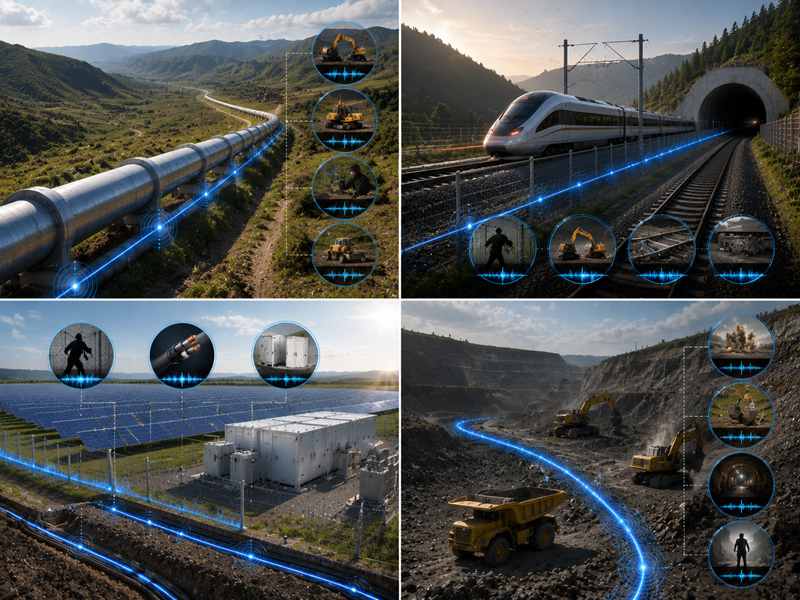
Pipeline Protection
Pipeline networks may extend across remote areas where unauthorized excavation, drilling, and mechanical impact can threaten infrastructure.
DAS provides:
- continuous monitoring along pipeline routes
- accurate event positioning
- reduced field equipment quantity
- compatibility with existing fiber communication systems
For oil, gas, and water transmission systems, DAS can become part of a wider fiber optic intrusion detection solution.
Railway Security Monitoring
Railway infrastructure includes tracks, tunnels, bridges, and restricted areas.
DAS can monitor:
- abnormal ground vibration
- unauthorized access near tracks
- excavation activities
- equipment-related vibration changes
Compared with point sensors, distributed sensing better matches the linear characteristics of railway networks.
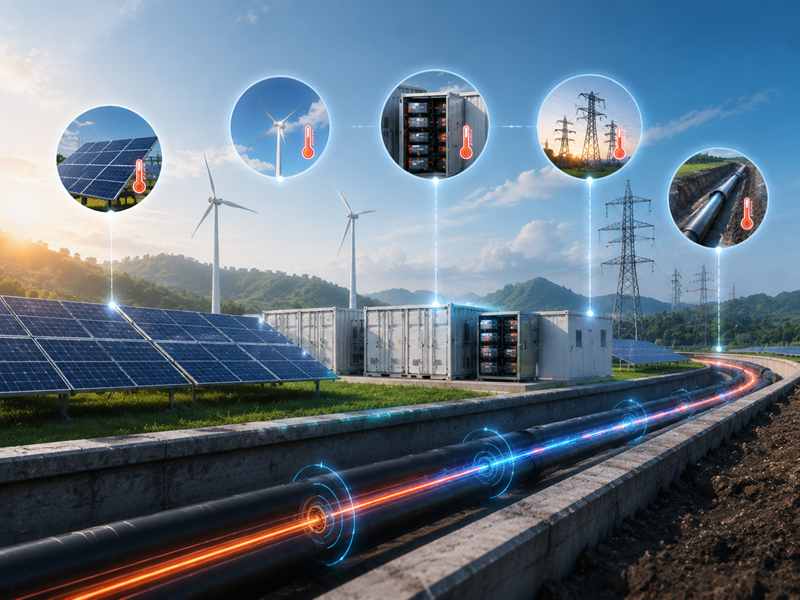
Solar Farm and Energy Facility Protection
Large renewable energy facilities often have wide boundaries and remote locations.
Ground monitoring requirements include:
- perimeter intrusion detection
- underground cable protection
- equipment area monitoring
DAS can be combined with perimeter intrusion detection systems to provide wider coverage with fewer field devices.
Mining and Excavation Monitoring
Mining areas involve complex underground and surface environments.
DAS can help monitor:
- underground vibration changes
- unauthorized excavation
- blasting activity patterns
- restricted area access
The system can be customized according to mine layout, fiber routes, and monitoring objectives.
Final Selection Guide
| Selection Factor | Recommended Solution |
| Monitoring Distance Above Several Kilometers | DAS |
| Fixed Detection Point | Seismic Sensors |
| Large Perimeter Protection | DAS |
| Underground Linear Infrastructure | DAS |
| Small Monitoring Area | Seismic Sensors |
| Existing Fiber Network Available | DAS |
| Need for Centralized Monitoring | DAS |
| Local Vibration Measurement | Seismic Sensors |
Seismic transducers excel at fixed-point vibration surveillance, whereas DAS utilizes fiber to realize full-length distributed monitoring.
Adjustable DAS systems adapt to diverse sites, delivering expandable monitoring for linear energy, rail and perimeter projects.