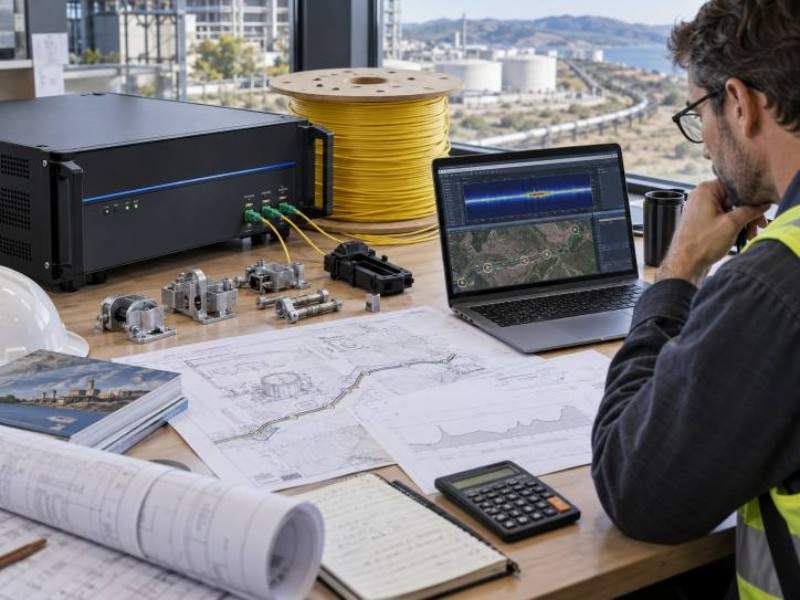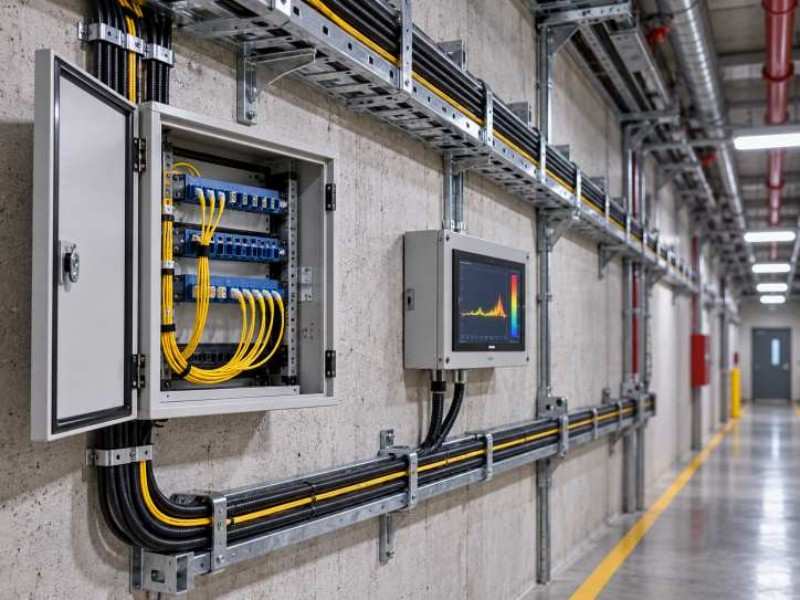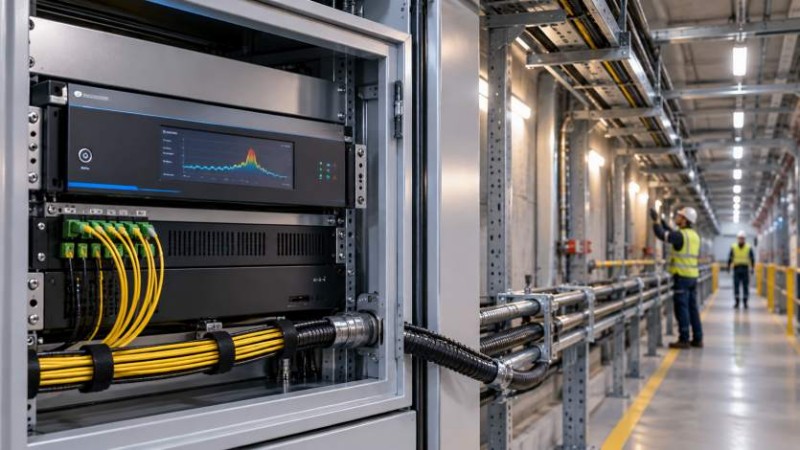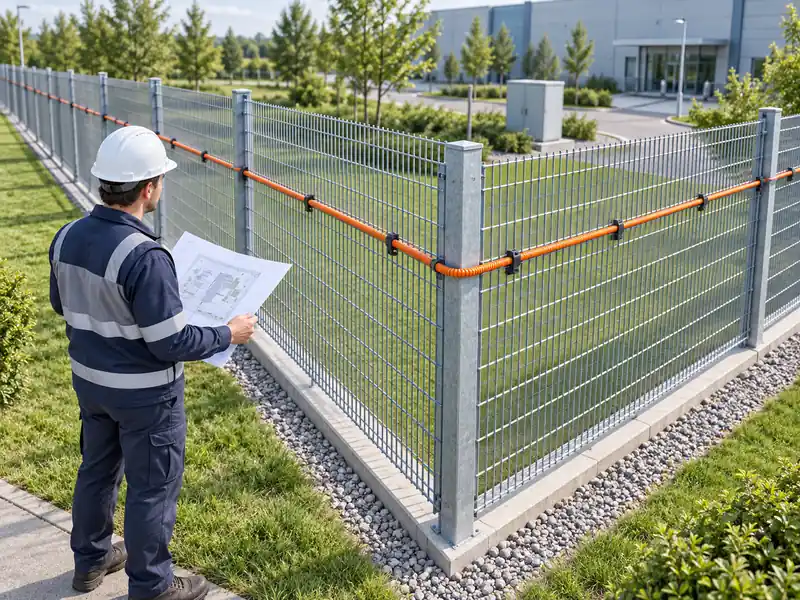
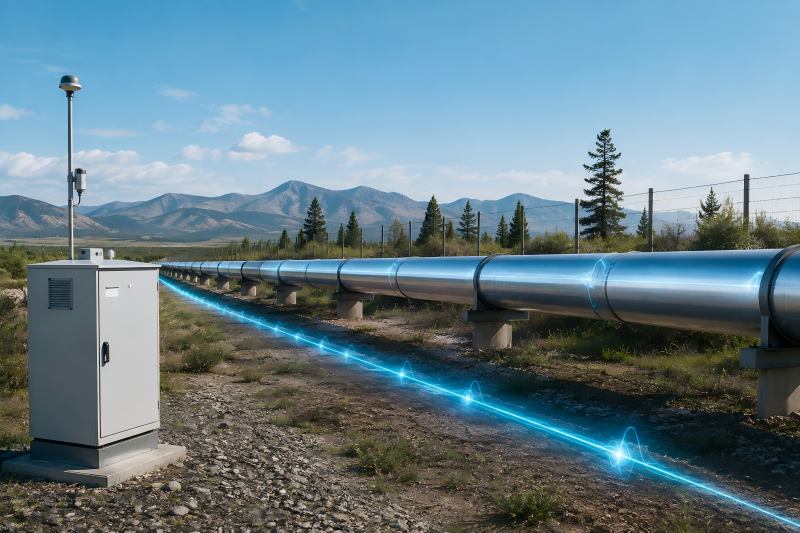
Pipelines often cross remote and complex environments, making long-distance security monitoring challenging. Traditional methods such as patrols, CCTV, and point sensors are useful but difficult to scale for extensive pipeline networks.
Distributed Acoustic Sensing (DAS) transforms optical fiber into a continuous sensing system to detect vibration events along the route. Rather than replacing all technologies, DAS provides a reliable solution for projects requiring wide-area coverage, early warning, and reduced maintenance.
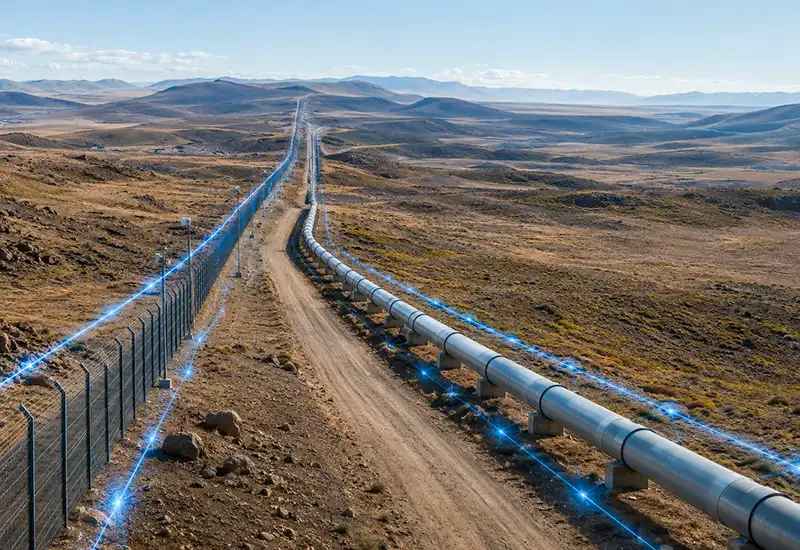
Distributed Acoustic Sensing in Pipeline Security: What Is It?
A fibre optic sensing technique called distributed acoustic sensing (DAS) uses an optical fibre connection to detect vibration and acoustic changes.
In a conventional security system, each sensor represents a fixed detection point. For example, a vibration sensor installed on a fence only monitors the area around that specific location.
For long-distance pipeline protection, this approach creates several challenges:
- More sensors are required as distance increases
- Communication and power infrastructure become more complicated
- Maintenance becomes difficult in remote areas
- Coverage gaps may appear between sensors
DAS takes a different approach.
The sensing component is the optical fibre. Laser pulses are sent through the fibre by a DAS interrogator, which then examines the backscattered light signals. The fiber’s optical properties alter in response to external vibration, which enables the system to pinpoint the disturbance’s position and characteristics.
For pipeline security applications, DAS can detect activities such as:
- Unauthorized excavation
- Personnel approaching restricted areas
- Vehicle movement near pipeline routes
- Mechanical interference
- Ground disturbance
The important difference is that DAS does not monitor several separate points. It monitors the entire fiber route as a distributed sensing area.
| Monitoring Method | System Characteristics | Engineering Consideration |
| Point-based sensors | Multiple sensors installed at fixed locations | More equipment and maintenance points |
| CCTV monitoring | Visual confirmation at selected locations | Limited coverage in remote areas |
| DAS technology | Continuous sensing along optical fiber | Requires proper fiber installation and signal configuration |
Why Pipeline Operators Are Considering DAS Technology
From a project engineering perspective, the biggest advantage of DAS is not simply its detection distance.
The more important benefit is reducing the complexity of monitoring large infrastructure corridors.
For example, protecting a short industrial perimeter may be easily achieved with cameras and electronic sensors. However, protecting a 50 km pipeline section introduces completely different challenges.
Engineers need to consider:
- How many devices are required?
- How will each device receive power?
- How will maintenance teams access remote locations?
- How can alarm information be transmitted and managed?
DAS changes the system architecture by moving much of the sensing function into the fiber itself.
This creates several practical advantages.
Continuous Monitoring Along Long Routes
Pipeline risks do not occur only at predefined points.
A security system installed every few hundred meters may miss activities occurring between detection units.
DAS provides continuous awareness along the fiber route, allowing operators to identify events wherever they occur.
Reduced Field Equipment Requirements
For remote pipeline projects, reducing field equipment is often a major consideration.
Every additional outdoor device introduces potential maintenance requirements:
- Weather exposure
- Power failure risks
- Communication problems
- Physical damage
Using fiber as the sensing medium reduces the number of active devices deployed along the pipeline.
Suitable for Remote Environments
Many pipelines operate in locations where regular inspection is expensive.
Because optical fiber does not require electrical power along the sensing section, DAS can be deployed in areas where installing powered sensors would be difficult.
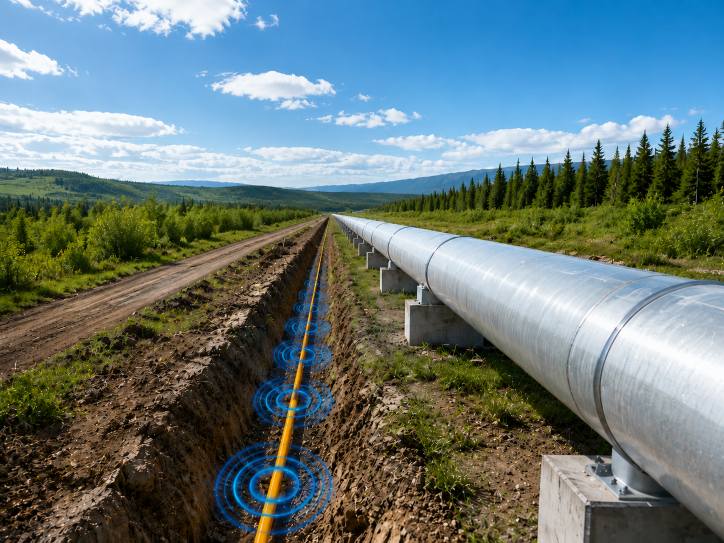
How DAS Detects Pipeline Security Events
Understanding how DAS works helps explain why installation quality and system configuration are so important.
1. Optical Transmission of Pulses
Laser pulses are sent via the fibre by the DAS interrogator.
The fiber can be installed:
- Alongside pipelines
- Inside protective conduits
- Underground near pipeline routes
The installation method depends on the project requirements.
From an engineering perspective, the fiber layout is not only a construction decision. It directly affects detection performance.
2. Vibration Signal Collection
When external activities occur near the pipeline, they create mechanical vibrations.
Examples include:
- Digging with heavy equipment
- Walking near the pipeline route
- Vehicle movement
- Ground impact
These vibrations influence the optical signals traveling through the fiber.
The DAS system measures these changes and converts them into usable information.
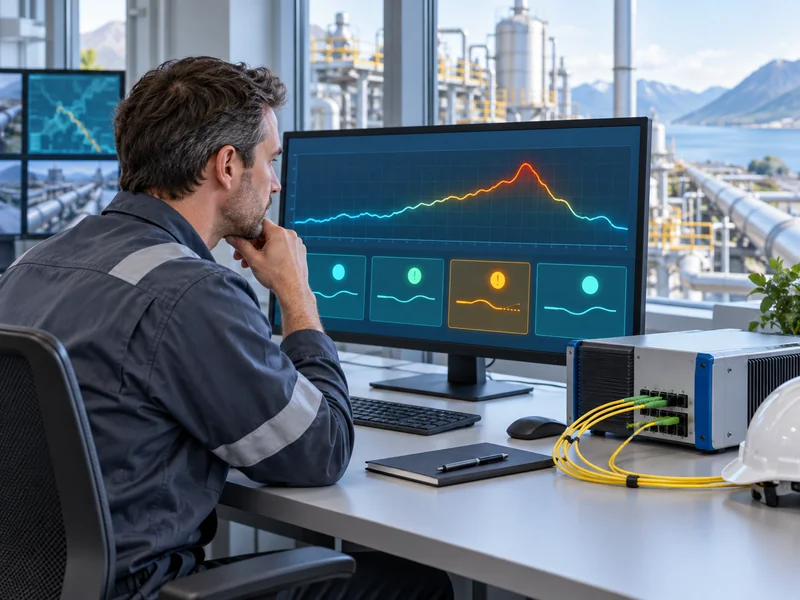
3. Event Classification and Alarm Analysis
In real projects, detection capability alone is not enough.
Pipeline environments naturally contain many sources of vibration.
For example:
- Nearby road traffic
- Agricultural activities
- Weather conditions
- Industrial machinery
Therefore, DAS systems need signal processing methods to distinguish between different vibration patterns.
| Event Type | Typical Characteristics |
| Human movement | Repeated low-frequency vibration |
| Excavation activity | Strong repetitive mechanical impact |
| Vehicle movement | Longer continuous vibration pattern |
| Environmental noise | Irregular background signals |
The engineering goal is not maximum sensitivity.
Finding a workable compromise between false alarm reduction and detection performance is the aim.
Engineering Considerations Before Deploying DAS
Although DAS provides significant advantages for pipeline protection, successful deployment depends heavily on engineering design.
Fiber Installation Is Critical
A common misunderstanding is that DAS performance mainly depends on the sensing equipment.
In reality, fiber installation conditions can have a major influence.
Factors that engineers need to evaluate include:
- Burial depth
- Soil characteristics
- Distance between fiber and pipeline
- Mechanical protection
- Environmental conditions
For example, a fiber installed too far from the vibration source may reduce signal strength. A poorly protected fiber route may increase maintenance risks.
Therefore, DAS projects should be designed based on the physical environment, not only equipment specifications.
False Alarm Management Should Be a Priority
During pipeline security projects, reducing false alarms is often more important than achieving the highest possible sensitivity.
A system that generates frequent unnecessary alarms creates operational problems:
- Security teams lose confidence
- Response resources are wasted
- Important alarms may be ignored
Experienced engineers usually configure DAS based on the actual environment.
A pipeline located near a highway requires different settings compared with a pipeline crossing a remote desert area.
DAS Compared With Other Pipeline Monitoring Technologies
DAS is powerful, but it is designed for specific monitoring requirements.
Different technologies address different pipeline risks.
| Technology | Main Function | Typical Use |
| DAS | Detects external vibration events | Intrusion detection and excavation monitoring |
| DTS | Detects temperature changes | Fire and thermal monitoring |
| CCTV | Provides visual confirmation | Specific locations and facilities |
| Pressure Monitoring | Monitors pipeline operation | Internal pipeline condition monitoring |
From a system integration perspective, DAS should usually be considered as one layer of a complete security solution.
A mature pipeline protection system may combine:
- DAS for early detection
- Cameras for verification
- GIS mapping for location display
- Security software for centralized management
Common Mistakes When Designing DAS Pipeline Security Systems
Choosing DAS Only Based on Distance
A longer pipeline does not automatically mean DAS is the best solution.
Engineers should evaluate:
- Threat type
- Installation environment
- Required response time
- Existing security infrastructure
Ignoring Installation Conditions
The same DAS equipment may perform differently under different installation methods.
The fiber environment must be considered during project design.
Focusing Only on Detection Capability
Security systems are not successful because they detect events.
They are successful because they help operators make decisions.
Alarm location, verification methods, and response procedures are equally important.
How System Integrators Should Evaluate DAS Solutions
For security contractors and system integrators, selecting a DAS solution requires more than comparing technical parameters.
Important evaluation factors include:
System Integration Capability
The DAS platform should work with existing security systems.
Questions to consider:
- Can alarms be displayed on existing platforms?
- Can the system connect with video management systems?
- Can operators easily understand alarm information?
Project Adaptability
Every pipeline project is different.
A suitable DAS solution should support adjustment based on:
- Pipeline length
- Installation method
- Environmental conditions
- Security objectives
Long-Term Reliability
Pipeline security systems are expected to operate continuously for many years.
Therefore, reliability, technical support, and maintenance strategy are important factors during selection.
Distributed Acoustic Sensing provides pipeline operators with a new approach to long-distance security monitoring. Its value lies not only in detecting vibration, but in providing continuous awareness where traditional monitoring methods are difficult to deploy and maintain.
DAS should be viewed by system integrators as a component of a comprehensive security architecture. When properly designed and integrated, it can improve early threat detection, response efficiency, and the overall reliability of pipeline protection systems.