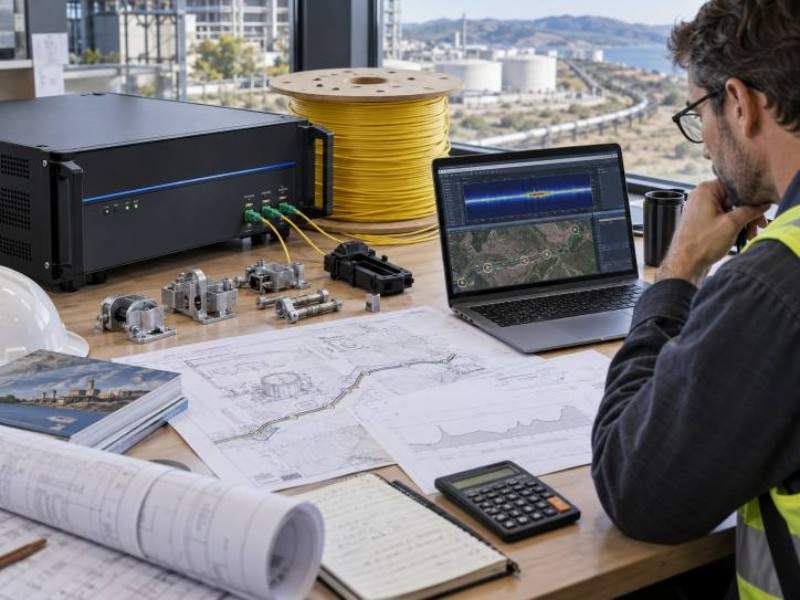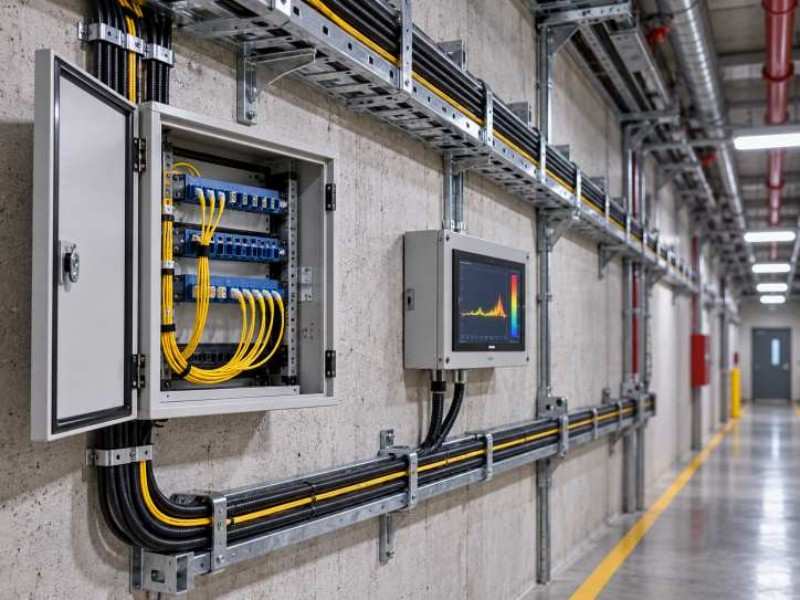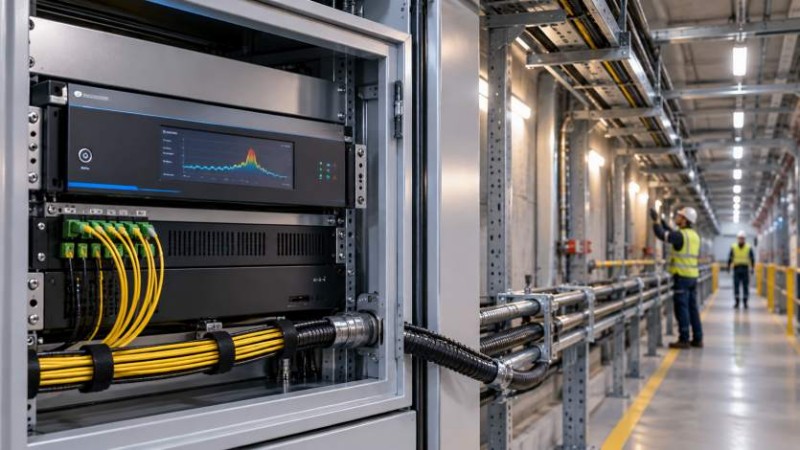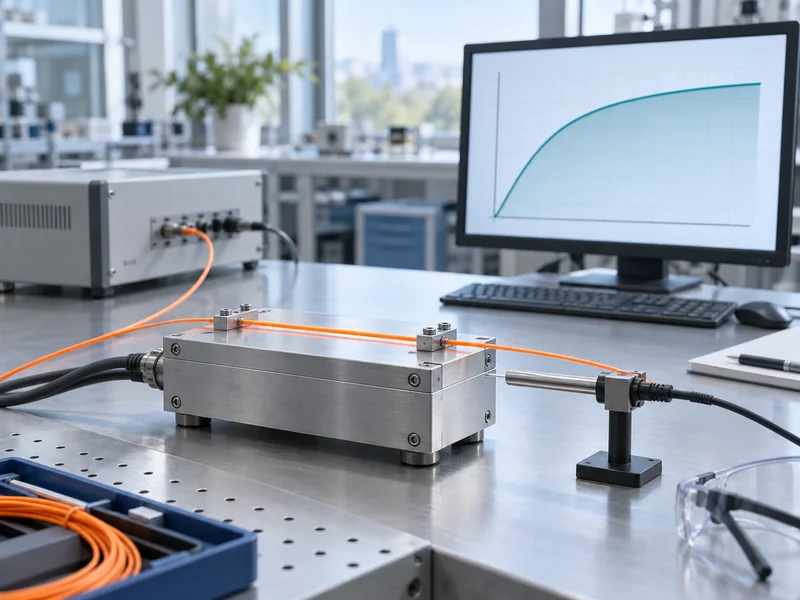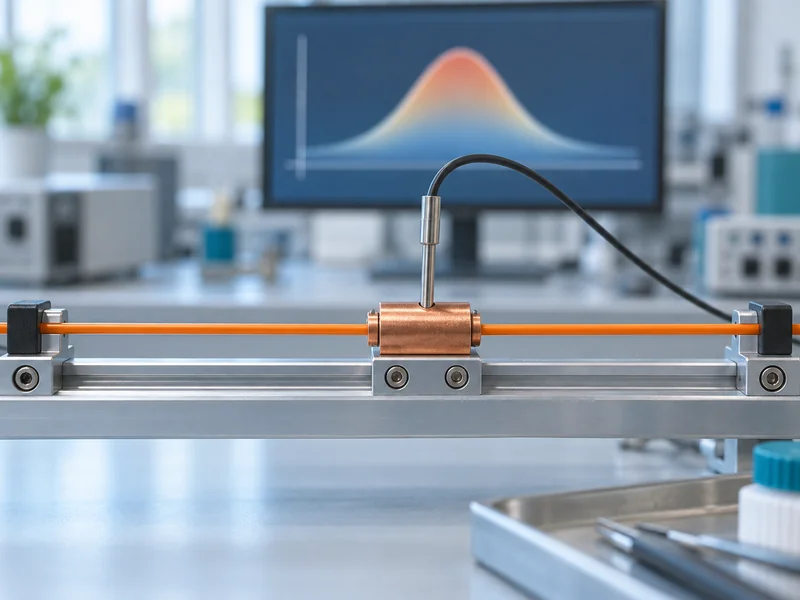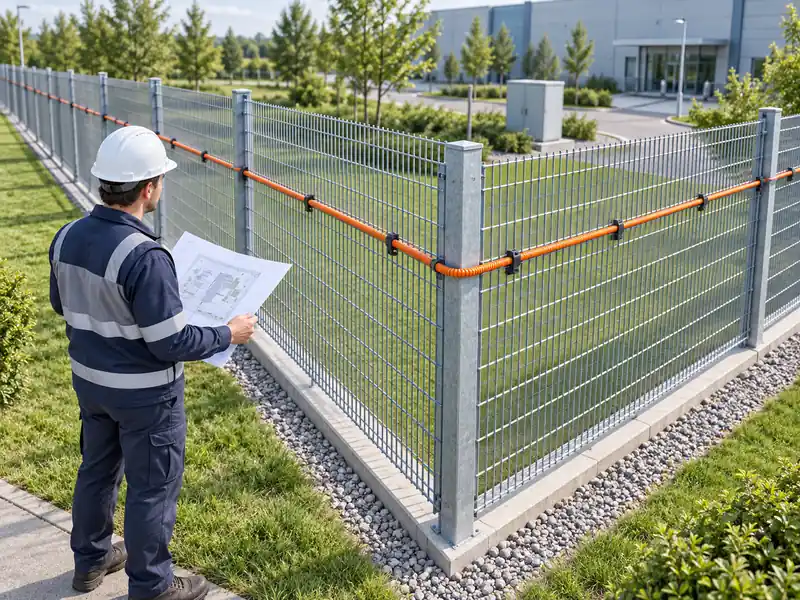
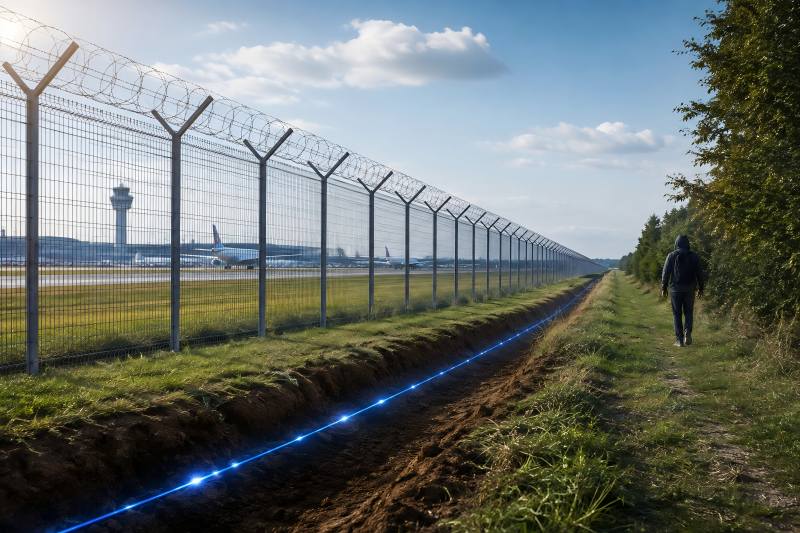
Distributed acoustic sensing, commonly abbreviated to DAS, measures how vibration deforms a light-carrying fiber at successive positions along a cable. A device called an interrogator sends laser pulses into the fiber and analyzes returning light to identify changes caused by mechanical disturbances. This allows one fiber to provide measurements at many locations along its route.
The word “distributed” describes how sensing takes place along the fiber, rather than only at separate, individually installed sensors. Depending on the system and installation, DAS can support monitoring across kilometers of infrastructure.
For engineers and asset owners, the practical questions are straightforward: what can the system detect, where can it work, and what determines whether its measurements become useful information?
How Does Distributed Acoustic Sensing Work?
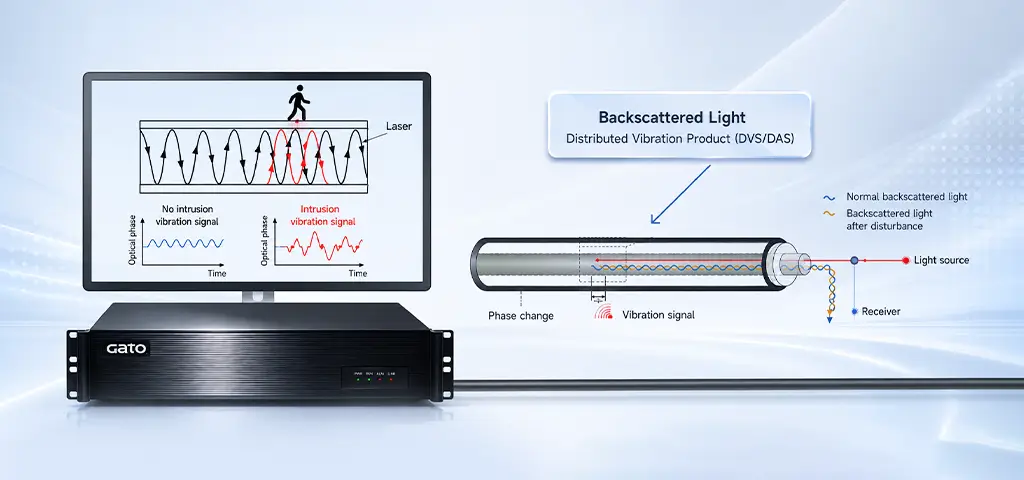
DAS uses changes in backscattered light to detect disturbances and locate them along a fiber. Most conventional DAS systems use Rayleigh backscattering, which occurs naturally as light travels through the glass.
The process has four main stages:
- Transmit light. The interrogator launches laser pulses into the optical fiber.
- Collect backscatter. Microscopic variations in the glass scatter a small portion of the light back toward the instrument.
- Measure changes. Vibrations stretch or compress the fiber slightly, changing the returning optical signal. Phase-sensitive systems analyze these changes to recover dynamic strain information.
- Locate the disturbance. The return time identifies the corresponding position along the fiber.
This optical measurement process produces vibration data. Application software then analyzes patterns to detect events and, where supported, classify their likely cause.
For example, climbing a fence can transfer mechanical vibration into an attached sensing cable. A security system can analyze that disturbance, assign it a location, and generate an alarm if it meets the configured detection criteria.
Which Components Turn Fiber Measurements into Usable Information?
A DAS installation combines optical measurement hardware, sensing fiber, and software. In security applications, alarm management and connections to other systems turn the measurements into an operational response.
| Component | Role |
| DAS interrogator | Sends optical pulses, receives backscatter, and converts the optical response into measurement data |
| Sensing fiber and cable | Carries light and receives strain from the surrounding environment or monitored structure |
| Optical connections | Connectors, splices, and lead-in sections connect the sensing route to the interrogator |
| Signal processing | Extracts useful vibration information and reduces unwanted signal effects |
| Event detection and classification | Identifies relevant activity using configured rules, signal features, or trained models |
| Management software | Displays events, stores records, and supports alarms or integration with other platforms |
The sensing fiber can operate without an electrical supply along the monitored route. The interrogator, processing equipment, network devices, and cameras still require power.
For a security operator, the useful output may be an event location and an associated video view. A research installation may instead require continuous acoustic measurements for further analysis. These different outputs influence system configuration and data-storage requirements.
Does DAS Require Special Fiber Optic Cable?
Not necessarily. For numerous DAS instruments, ordinary telecom-grade optical fiber provides a suitable sensing medium. Existing fiber may be reusable when its type, optical condition, access arrangements, and route suit the application.
Single-mode fiber is widely used. An unused strand within a communications cable—often called dark fiber—can provide a sensing path without using the strands carrying communications traffic. Using an active communications strand requires a compatible design and specific validation.
Optical compatibility is only part of the assessment. The cable must also receive useful vibration from the area being monitored.
Before reusing a cable, check:
- Route: Does it pass close enough to the target events?
- Optical condition: Are attenuation, splices, and connections acceptable for the selected equipment?
- Mechanical coupling: How effectively does vibration reach the fiber?
- Installation: Is the cable buried, attached to a fence, or installed within a duct?
- Access and maintenance: Can the required fiber be connected, tested, and repaired?
A cable can transmit light successfully while providing weak sensing performance for a particular event. Before selecting or reusing a sensing route, review the optical and installation checks in our DAS deployment requirements guide.
What Can Distributed Acoustic Sensing Detect?
DAS detects disturbances that produce measurable strain in the fiber. Event-recognition software can then interpret those measurements for a particular application.
In perimeter and infrastructure monitoring, possible targets include:
| Event | How vibration can reach the fiber |
| Walking near buried cable | Footsteps transmit vibration through the ground |
| Fence climbing | Movement deforms and vibrates the fence |
| Fence cutting | Cutting or impacts create mechanical disturbances |
| Vehicle movement | Ground vibration reaches a nearby sensing route |
| Excavation | Manual digging or machinery generates repeated disturbances |
| Tampering with infrastructure | Impacts or movement couple into an attached or nearby cable |
These are potential detection scenarios, not guarantees for every installation. FEBUS, for example, evaluates different fence and buried-cable configurations because installation conditions affect the measured response.
Detection and identification should also be evaluated separately. A system may register a disturbance without reliably determining its cause. Useful event classification depends on signal quality, the surrounding activity, and how the detection software has been configured and validated.
How Far Can DAS Monitor, and How Accurate Is It?
DAS can monitor long fiber routes, but the usable distance depends on the equipment, optical losses, measurement settings, and required signal quality. Some commercial systems offer monitoring beyond 100 kilometers under specified conditions. That figure describes distance along the fiber, not a detection radius around it.
Several specifications need to be distinguished:
| Term | Meaning |
| Sensing range | The length of fiber that can be monitored under stated conditions |
| Channel spacing | The distance between successive reported measurement positions |
| Gauge length | The fiber interval over which a strain measurement is made |
| Spatial resolution | How closely spaced two disturbances can be while remaining distinguishable in the measurement |
| Location accuracy | How closely a reported event position matches its actual position |
Channel spacing and gauge length describe different aspects of the measurement. For example, Silixa explains that its iDAS measurements use a window defined by gauge length, while channel spacing determines the positions at which measurements are reported.
When comparing systems, request definitions and test conditions for each quoted specification. A small channel spacing alone does not establish the accuracy of a mapped intrusion alarm.
How Is DAS Different from Other Fiber Optic Sensing Technologies?
Distributed fiber optic sensing is a broader family of technologies. DAS primarily addresses dynamic strain and vibration, while other methods are designed for temperature or longer-term strain measurements.
| Technology | Main measurement focus | Typical purpose |
| DAS — Distributed Acoustic Sensing | Dynamic strain and vibration | Acoustic monitoring, intrusion detection, seismic measurements |
| DTS — Distributed Temperature Sensing | Temperature along a fiber | Thermal monitoring and heat detection |
| DSS — Distributed Strain Sensing | Strain along a fiber, commonly including slower changes | Deformation and structural monitoring |
DAS and DTS therefore answer different questions. A security application may need to identify an excavation event, while a thermal-monitoring application needs a temperature profile. Some projects combine sensing methods to address both requirements.
Fiber Bragg grating, or FBG, sensing is another optical approach. It uses deliberately formed gratings as sensing elements; it should not be treated as another name for continuous DAS measurement.
Common Applications of Distributed Acoustic Sensing
DAS is useful where measurements are needed along an extended route. The required cable design, software, and validation depend on the application.
Pipeline Security
A sensing route near a pipeline can help identify excavation, vehicle activity, or other third-party interference. The operational objective is to alert the operator to potentially damaging activity while there is still time to investigate.
Security monitoring and leak detection require different validation. A system proven to detect excavation should not automatically be assumed to detect every leak.
Perimeter and Border Protection
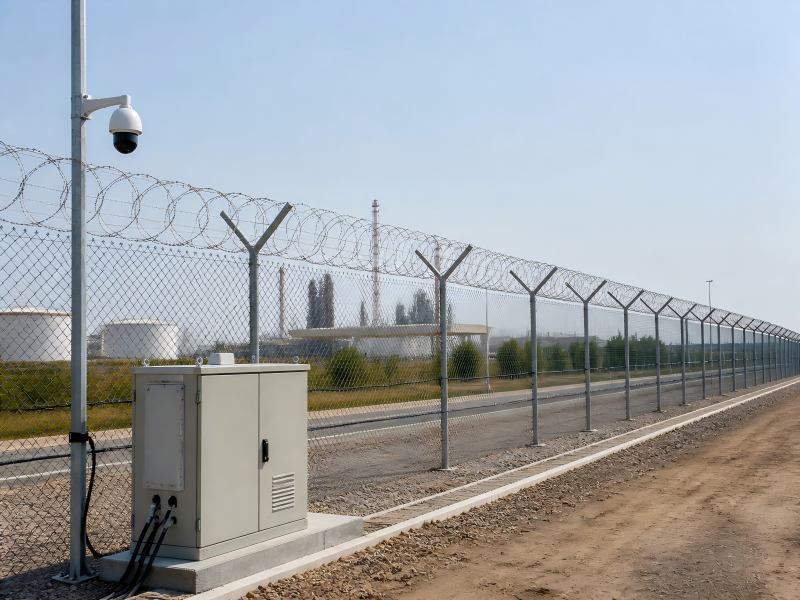
Fence-mounted or buried fiber can support intrusion detection along large boundaries. Relevant sites include airports, industrial facilities, energy installations, and other locations where security teams need to locate events across an extensive perimeter.
Railways and Power Infrastructure
Application-specific systems can monitor vibrations associated with transport activity or disturbances near infrastructure. The usefulness of a measurement depends on which event the operator needs to detect and how reliably it can be distinguished from normal operations.
Geophysical and Oilfield Monitoring
DAS also supports seismic measurements and specialized oilfield applications. These may require calibrated acoustic data and processing methods that differ from a perimeter alarm system.
How Does DAS Support Perimeter Security?
In perimeter security, DAS provides a way to detect and locate suspicious activity along a sensing route. Site procedures and connected security equipment turn each sensor alert into an investigation and, where necessary, a response.
A typical sequence is:
Fence or ground disturbance → fiber measurement → event analysis → located alarm → video verification → security response
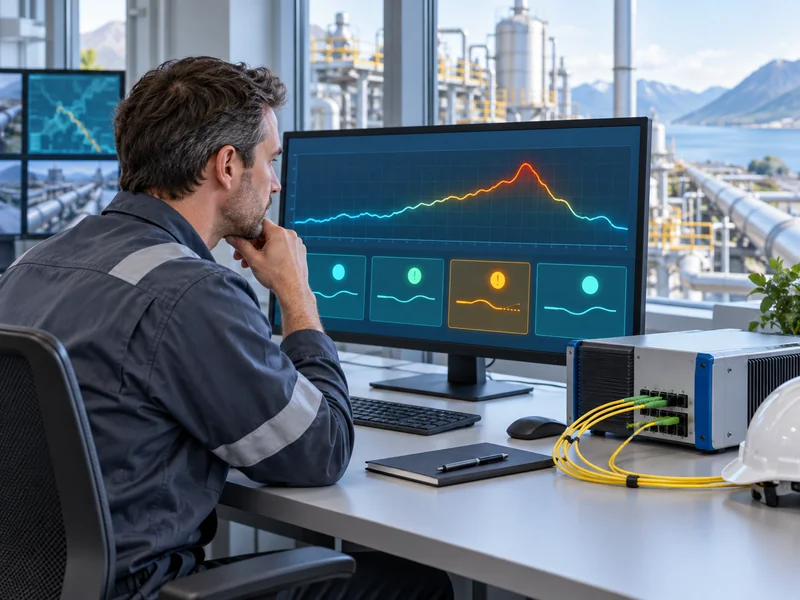
Consider a person climbing a protected fence. The cable receives the resulting vibration, and the system evaluates the signal against its detection criteria. If an alarm is generated, the management platform can display the location and call up a relevant camera view.
By reviewing the alarm position alongside the camera footage, control-room staff can decide whether the disturbance requires intervention. The GATO SAM300 alarm management platform supports alarm-linked video and map-based management, helping security teams locate, verify, and respond to events.
Gates, authorized maintenance, different fence structures, and nearby traffic all influence system design. For a practical overview of deployment, alarm handling, and project planning, read our complete guide to DAS for perimeter security.
What Affects DAS Performance in Real Installations?
Reliable performance depends on the entire installation, including the cable, optical path, processing, and operating environment.
Vibration Transfer
The event must produce a usable signal at the fiber. Soil conditions, cable attachment, fence condition, and installation geometry can all influence that transfer.
Background Activity
Wind, vehicles, machinery, and normal site operations can produce vibration. Detection settings must account for this activity while retaining sensitivity to the required intrusion scenarios.
Commissioning and Verification
Performance should be tested at representative locations using agreed scenarios and recorded settings. A successful demonstration at one convenient location does not establish performance across the complete route.
Reliable detection requires suitable installation, representative field testing, and settings matched to local conditions. Our guide to improving DAS alarm accuracy explains how cable coupling, environmental noise, and event classification affect the quality of alarms.
Distributed Acoustic Sensing FAQs
Can DAS Distinguish People from Animals?
Event-classification software may distinguish different vibration patterns, but reliability depends on the installation and available signal. Testing should include both the intrusion targets and the environmental activity expected at the site. Lowering unwanted alarms is useful only if the system retains the required detection performance.
Does Rain Cause False Alarms?
Rain and weather-driven movement can create disturbances in an installed system. Whether they produce alarms depends on the cable installation and detection settings. Suitable installation, event classification, and local tuning help manage these effects.
Can DAS Detect Pipeline Leaks?
Some systems use acoustic measurements as part of a leak-detection solution. Suitability depends on the pipeline, fluid, operating conditions, sensing arrangement, and required leak-detection performance. Dedicated testing is needed; detecting digging near a pipeline does not prove leak-detection capability.
What Happens If the Sensing Fiber Is Cut?
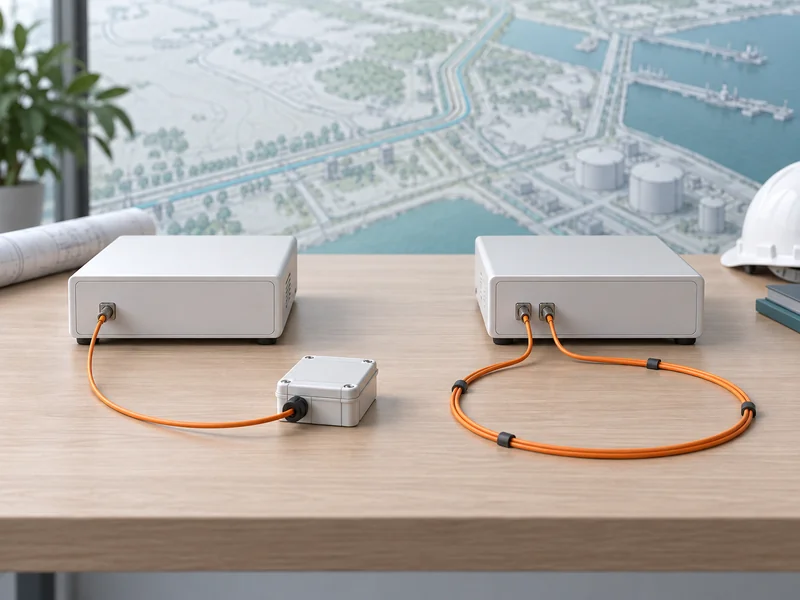
In a conventional single-ended arrangement, a break interrupts access to the fiber beyond that point. Supported dual-ended or loop configurations can provide alternative access after a single break. The actual remaining coverage depends on the system architecture and damage location.
How Much Does a DAS System Cost?
A useful estimate must include the interrogator, sensing cable, installation, software, integration, commissioning, and maintenance. Existing usable fiber can change the project economics substantially. Quotations should therefore be compared against the same route, detection requirements, and scope of work.
How Do I Assess DAS for My Site?
Start with the events you need to detect, the proposed sensing route, existing fiber information, and the required alarm response. These details establish what should be evaluated during system selection and field testing.
For perimeter protection projects, explore the GATO F7 DAS fiber optic intrusion detection system and compare its deployment options with your site requirements.