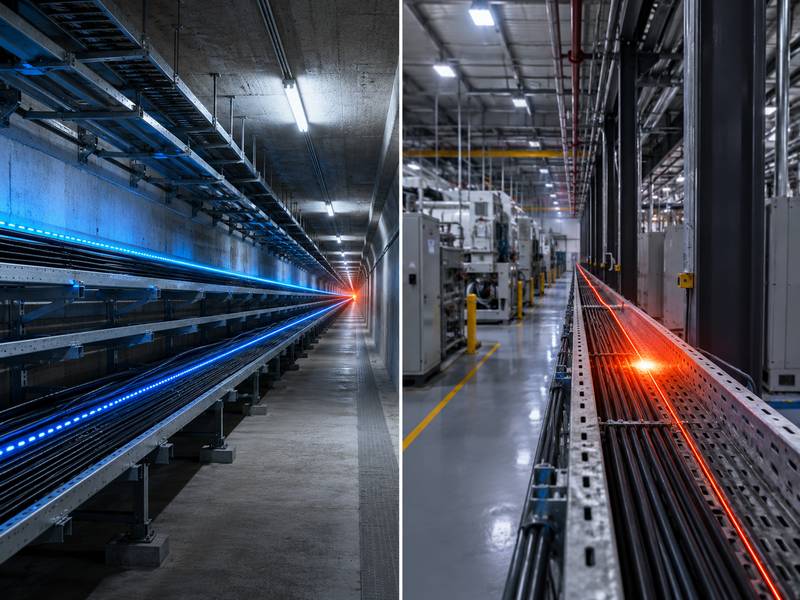
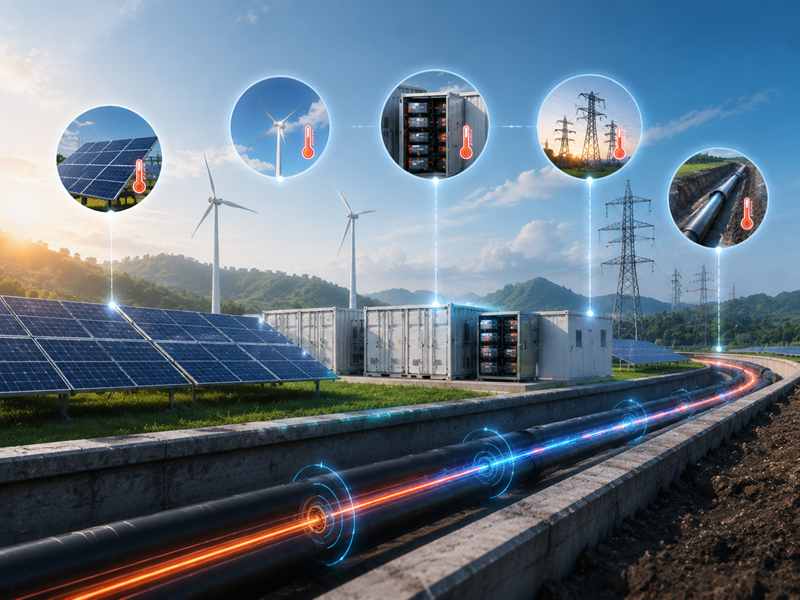
Renewable energy projects require continuous monitoring to identify thermal risks, improve stability, and protect critical assets across complex infrastructures.
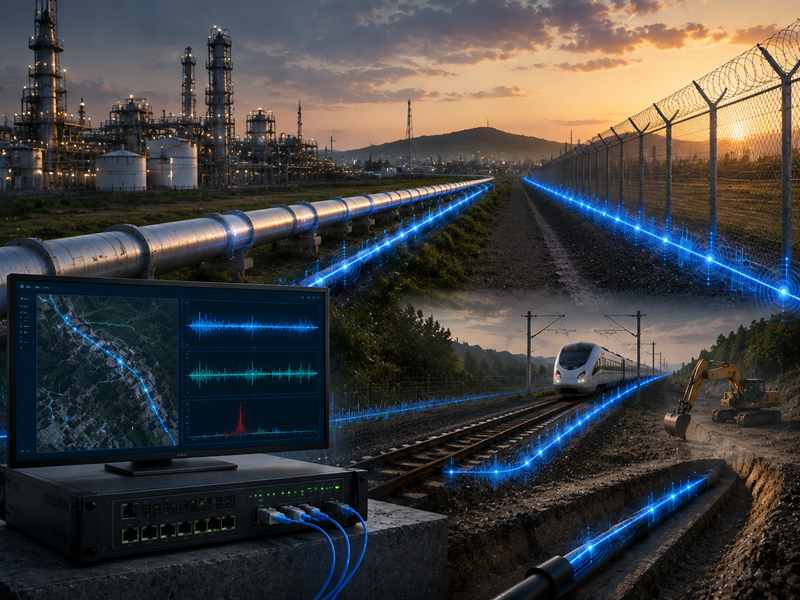
Distributed Temperature Sensing uses optical fiber to detect temperature changes along long-distance routes, enabling accurate thermal monitoring.
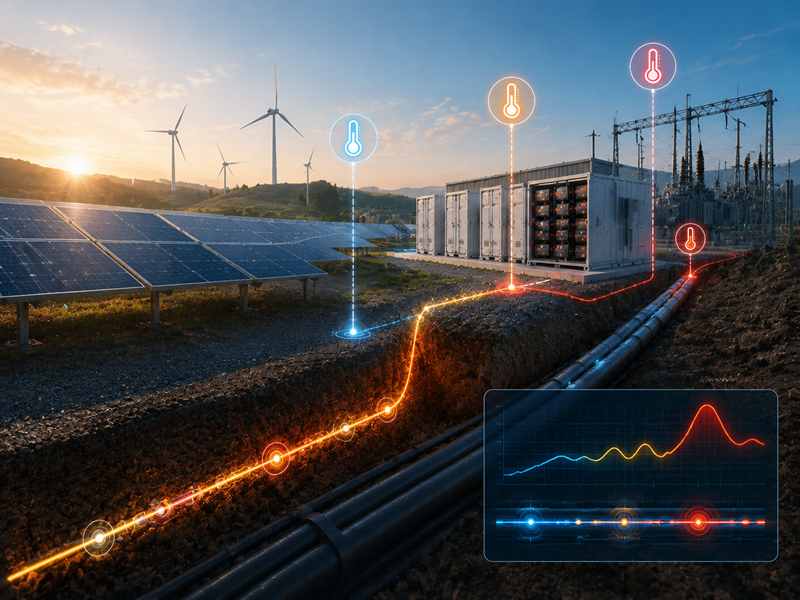
Distributed Temperature Sensing for Renewable Energy Infrastructure
Renewable energy facilities cover large areas where traditional monitoring methods face limitations in maintaining continuous equipment visibility and reliability.
DTS uses optical fibers to detect temperature changes across solar, wind, and storage systems, providing accurate thermal distribution data.
The main monitoring advantages include:
- Continuous temperature measurement along long-distance fiber routes
- Real-time identification of abnormal temperature increases
- Reduced dependence on manual inspection
- Suitable operation in harsh outdoor environments
- Compatibility with underground and enclosed installations
| Monitoring Method | Coverage Mode | Suitable Application | Limitation |
| Point Temperature Sensor | Fixed monitoring points | Small equipment areas | Cannot detect issues between sensors |
| Thermal Camera | Surface imaging | Equipment inspection | Requires visibility and fixed positions |
| Linear Heat Detection Cable | Continuous heat detection | Fire protection applications | Mainly provides alarm signals |
| Distributed Temperature Sensing | Full fiber route monitoring | Renewable energy infrastructure | Requires professional system design |
How DTS Supports Solar Power Plant Monitoring?
Solar farms face changing weather, radiation, dust, and electrical loads, making continuous temperature monitoring essential for stable operation.
Large photovoltaic systems require cable monitoring to detect overheating risks, protect insulation performance, and prevent unexpected equipment failures.
Underground Cable Temperature Monitoring
Subsurface power cables for renewable energy projects are deployed within intricate geologic environments, rendering direct manual inspection impractical.
Temperature increases along cable routes may indicate:
- Overloaded cable sections
- Poor heat dissipation
- Cable joint problems
- Insulation degradation
- Abnormal current distribution
By installing optical fiber along cable routes, DTS can provide temperature profiles over long distances.
| Solar Plant Monitoring Area | DTS Application | Main Detection Purpose |
| Underground Cable Trench | Fiber installed near power cables | Detect overheating sections |
| Inverter Station | Equipment temperature monitoring | Identify abnormal operation |
| Transformer Area | Thermal condition monitoring | Support preventive maintenance |
| Battery Storage Area | Temperature distribution monitoring | Improve thermal safety |
DTS Applications in Wind Energy Systems
Wind power stations feature scattered turbine units demanding stable monitoring; extensive cable lines bring obstacles to real-time temperature control.
DTS technology delivers effective temperature surveillance for wind facilities, enabling staff to spot overheating faults and boost maintenance efficiency.
Wind Turbine Cable Monitoring
Power cables inside wind turbines experience continuous mechanical and electrical stress.
Temperature monitoring can help identify:
- Cable overload conditions
- Connection point heating
- Converter temperature abnormalities
- Transformer thermal changes
For offshore wind farms, DTS provides additional value because maintenance access is limited by weather conditions and transportation availability.
A temperature monitoring system installed along submarine or underground cables can continuously track thermal conditions without requiring frequent physical inspection.
| Wind Energy Component | Monitoring Challenge | DTS Function |
| Submarine Cable | Difficult access environment | Continuous thermal monitoring |
| Turbine Internal Cable | High electrical load | Detect overheating |
| Collection Network | Long distance distribution | Locate abnormal temperature points |
| Substation Equipment | Critical power conversion area | Support predictive maintenance |
DTS for Battery Energy Storage Systems (BESS)
As core supporting facilities for renewable energy construction, battery energy storage systems mitigate the intermittency and volatility of solar and wind power generation.
Stringent thermal regulation is a necessity for battery equipment. Thermal imbalance between modular battery units impairs operating efficiency, accelerates capacity attenuation and introduces critical safety threats.
Conventional point-type temperature sensors merely sample partial areas, resulting in incomplete coverage inside large-capacity energy storage enclosures. DTS supports real-time continuous thermal profile monitoring throughout battery containers and associated mechanical and electrical equipment.
Battery Thermal Monitoring Requirements
A DTS system can monitor:
- Battery rack temperature
- Container internal temperature distribution
- Cable connection temperature
- HVAC performance conditions
- Abnormal heat concentration areas
| BESS Area | Temperature Monitoring Target | DTS Value |
| Battery Rack | Cell temperature variation | Identify thermal abnormality |
| Power Connection Area | Cable joint heating | Detect electrical stress |
| Container Interior | Overall thermal distribution | Optimize cooling control |
| Energy Storage Yard | Multiple container monitoring | Centralized management |
DTS records temperature changes of energy storage systems, enabling managers to observe device performance under charge, discharge and high-load conditions.
Distributed Temperature Sensing for Renewable Energy Transmission Systems
Renewable energy generation infrastructures are frequently deployed in remote areas separated from energy-consuming districts. Long-distance transmission infrastructure becomes a critical part of project reliability.
Underground cables, cable tunnels, and transmission corridors require continuous monitoring because failures can cause significant power interruption.
Cable Temperature Monitoring with DTS
The system can identify:
- Hot spots along cable routes
- Uneven thermal distribution
- Cooling condition changes
- Cable overload areas
Distinct from traditional detection technologies, distributed temperature sensing (DTS) realizes synchronous acquisition of thermal parameters and spatial positioning information.
This allows operators to answer two important questions:
- Is the cable temperature abnormal?
- Where exactly is the abnormal section?
| Cable Monitoring Parameter | DTS Capability |
| Monitoring Distance | Suitable for long-distance fiber routes |
| Temperature Measurement | Continuous distributed measurement |
| Location Identification | Determines abnormal temperature position |
| Operation Mode | Real-time monitoring |
| Installation Method | Underground, tunnel, tray, or buried cable routes |
DTS Integration with Renewable Energy Security Systems
Solar farms, substations, and energy storage parks often have:
- Long fences
- Remote locations
- Limited personnel access
- Large monitoring areas
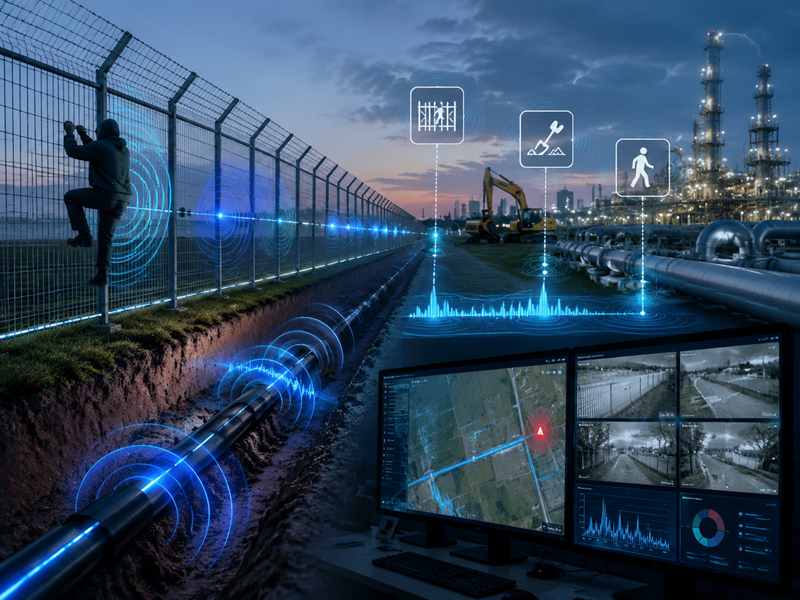
Temperature monitoring can be combined with other fiber optic security technologies to create a comprehensive protection system.
By combining DTS with fiber optic monitoring technologies, renewable energy operators can manage both equipment safety and site security through a unified platform.
| System Integration | Monitoring Target | Application |
| DTS + Cable Monitoring | Thermal condition | Power cable protection |
| Fiber Optic Intrusion Detection | Physical access | Solar farm perimeter security |
| CCTV Integration | Visual confirmation | Alarm verification |
| Control Center Platform | Centralized management | Large renewable projects |
DTS Performance Parameters for Renewable Energy Monitoring
Temperature Accuracy
Temperature measurement precision determines the credibility of system alarms. Renewable energy installations run amid variable ambient environments, hence DTS must maintain steady measuring performance to separate routine temperature swings from hazardous overheating.
Spatial Resolution
Spatial resolution defines the localization accuracy of temperature variation events. For long-haul cable monitoring scenarios, accurate spatial data is critical to support maintenance personnel in fast localization of defective cable segments.
Response Time
High response speed is a core requirement for electrical apparatus and battery energy storage systems. Preemptive thermal anomaly identification facilitates timely control measures, preventing mild temperature drift from evolving into catastrophic equipment malfunctions.
DTS Deployment Examples in Renewable Energy Projects
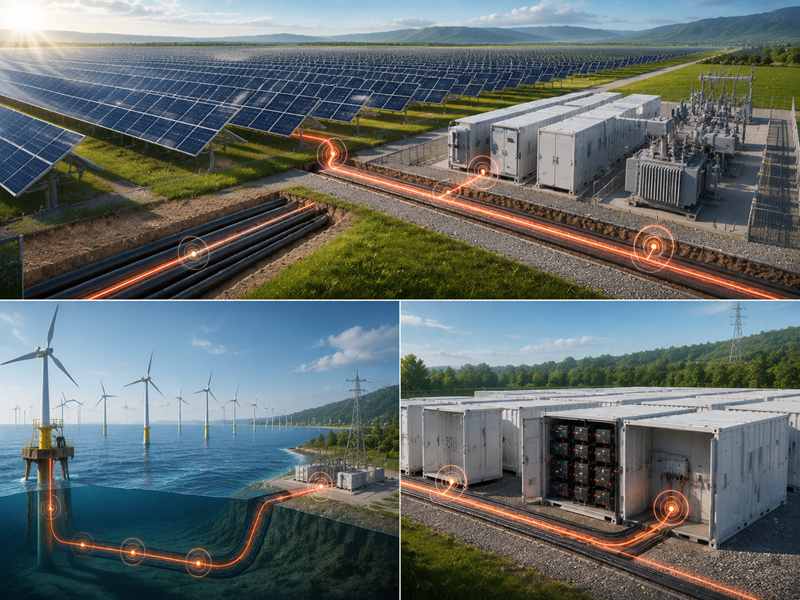
Solar Energy Projects
Solar farms typically require DTS monitoring for:
- Underground power collection cables
- Inverter connection areas
- Transformer stations
- Battery storage systems
Distributed Temperature Sensing (DTS) is highly applicable to long-span cable infrastructure. A single optical sensing fiber achieves large-area coverage, removing the requirement for massive distributed point sensors.
Wind Energy Projects
Wind farms often include distributed turbines connected through long cable networks.
DTS can monitor:
- Turbine power cables
- Submarine cables
- Collection systems
- Substation connections
For offshore projects, continuous monitoring reduces the need for frequent offshore inspection.
Energy Storage Projects
Battery storage facilities require accurate temperature monitoring because thermal conditions directly influence system operation.
DTS can provide:
- Container-level monitoring
- Rack temperature analysis
- Cable connection monitoring
- Thermal trend analysis
DTS offers uninterrupted thermal monitoring for large renewable facilities like wind turbines, solar plants, storage and power grids.
Tailored DTS solutions protect energy equipment with precise temperature detection and system linkage for stable, secure power supply.