June 11, 2025

Laser Beam Alarm Systems Improve Residential Perimeter Security
Blogs

How Laser Beam Alarm Systems Improve Residential Perimeter Security

As residential security advances, laser beam alarm systems offer precise, reliable, and discreet protection. This article covers how they work, their benefits, installation tips, smart home integration, and real-world uses. Understanding Laser Beam Alarm Systems A laser beam alarm system is a type of intrusion detection technology that uses invisible beams of laser light to detect movement or presence within a defined area. When an object, person, or animal interrupts the laser beam, the system triggers an alarm or alert. These systems typically consist of: Laser transmitter units that emit an invisible beam. Receiver units that detect the uninterrupted beam. Control panels or hubs that interpret signals and activate alarms. Alert outputs such as sirens, lights, or mobile notifications. Laser beams used in residential perimeter systems are often infrared (IR) and invisible to the human eye, making the setup discreet and difficult for intruders to detect. How Laser Beam Alarm Systems Work The working principle is simple but effective: The transmitter projects a narrow laser beam toward the receiver, forming a continuous optical link. The receiver constantly monitors the presence of this beam. If anything crosses the beam’s path—breaking the connection—a signal is sent to the control unit. Depending on the configuration, the system may trigger a local alarm, send alerts to a mobile device, activate lights, or notify a security company. Some advanced systems also incorporate dual-beam or multi-beam setups, which reduce false alarms by requiring multiple beams to be interrupted simultaneously before triggering an alert. Advantages of Laser Beam Alarm Systems in Residential Settings Precise Intrusion Detection Laser beam systems are incredibly accurate. Because the beam path is narrow and well-defined, the system can detect exactly when and where an intrusion occurs. This enables: Clear perimeter boundaries. Instant response to specific breach points. Reduced ambiguity compared to motion detectors or magnetic sensors. Minimal False Alarms False alarms are a major concern in any residential security setup. Traditional systems may trigger alerts due to animals, wind-blown branches, or shifting shadows. In contrast, laser beam systems: Use adjustable sensitivity levels. Can be set up as a dual-beam to confirm real intrusions. They are largely unaffected by light, sound, or minor vibrations. This reliability reduces unnecessary panic and ensures that alarms correspond to genuine threats. Discreet and Aesthetic Installation Unlike bulky cameras or visible infrared sensors, laser beam systems can be installed subtly. The components are often compact and can be hidden among landscaping, pillars, fences, or garden lights. This aesthetic advantage is ideal for homeowners who want security without visual clutter. Long-Range Coverage Laser beams can cover long distances—ranging from a few meters up to hundreds—making them ideal for covering: Driveways Backyards Garden perimeters Property boundaries One system can effectively secure large areas with fewer components than traditional methods, leading to lower maintenance and installation costs. Low Power Consumption Most laser beam systems are designed for efficiency and operate on low voltage. Many even come with solar-powered options or battery backup systems, ensuring reliable function during power outages or in off-grid installations. Applications in Residential Perimeter Security Laser beam alarm systems are versatile and can be used in various parts of a residential property. Typical applications include: Driveway and Entry Point Monitoring Install laser beams across driveways or walkways to detect unauthorized entry by people or vehicles. When someone crosses the beam, the homeowner receives an immediate notification. Fence Line Protection Laser beams aimed parallel to hedges or fences can identify attempts to breach the boundary or climb. This setup provides a virtual “tripwire” that alerts homeowners before intruders reach the house. Garage and Gate Security Positioning sensors near garages, sheds, or side gates helps monitor less-trafficked access points that are commonly exploited by intruders. Swimming Pool or Backyard Safety Besides security, laser beams can also be configured to alert when children or pets enter areas like pools or tool sheds, improving safety and accident prevention. Integration with Smart Home Systems Modern laser beam alarm systems are compatible with smart home ecosystems. This allows homeowners to: Receive mobile notifications via apps. Integrate alarms with smart cameras and lighting. Automate responses, such as turning on outdoor floodlights when the beam is broken. Control and monitor their security system remotely. By combining laser detection with smart cameras, users can receive not only an alert but also a visual confirmation, making decision-making faster and more accurate. Laser Beam vs. Other Residential Security Technologies Feature/Technology Laser Beam Alarm System Motion Detector CCTV Cameras Infrared Sensors Detection Accuracy High Medium Visual only Medium False Alarm Rate Low High N/A Medium-High Visibility Hidden Often visible Highly visible Visible or semi-hidden Real-Time Alerts Yes Yes Depends on setup Yes Coverage Area Long range, linear Wide, shorter Point-specific Wide Integration Easy with smart systems Yes Yes Yes Considerations When Installing Laser Beam Alarm Systems Line-of-Sight Requirement Laser beams require a clear and uninterrupted line of sight between the transmitter and receiver. Trees, tall grass, or furniture must be placed outside the beam path to ensure proper functioning. Environmental Factors While laser systems are resilient, they can be affected by: Heavy fog Snow or ice buildup Extreme temperature swings Choosing high-quality, weatherproof models and regular maintenance can mitigate these issues. Height and Positioning Proper height positioning helps avoid false triggers from small animals while ensuring human intrusions are captured. Dual-beam setups (at knee and chest height) are especially effective for this. Power Source and Backup Ensure a consistent power supply—either through direct wiring or solar panels with battery backup. Some systems also allow USB charging for portable configurations. Laser beam alarm systems offer precise, low-false-alarm protection with smart home integration—ideal for homes of all sizes. They deliver fast, discreet, and reliable security in an evolving threat landscape.


Fiber Optic Sensors in Oil & Gas
Blogs

Types of Fiber Optic Sensors Used in Oil and Gas Monitoring

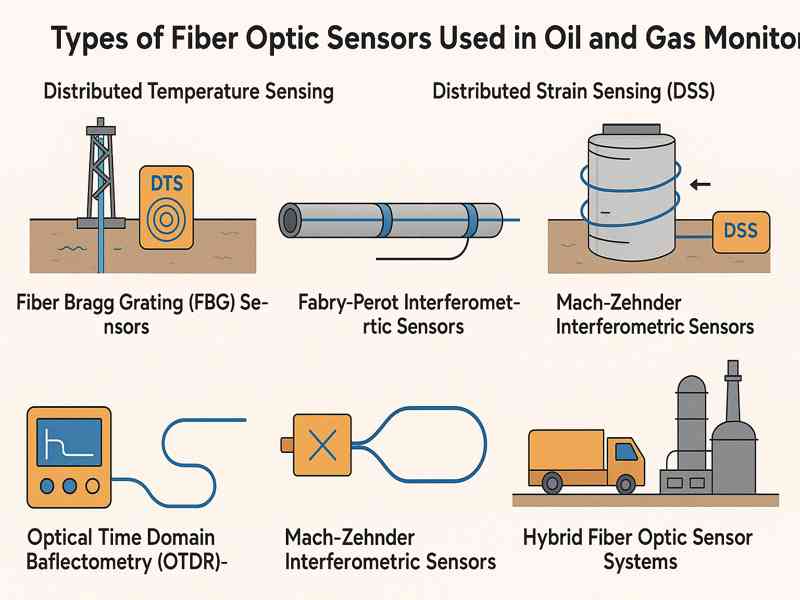
High pressure, heat, corrosion, and remote locations are some of the harsh conditions that the oil and gas sector must deal with. Accurate monitoring is vital for safety, efficiency, and environmental protection. Fiber optic sensors, immune to electromagnetic interference and ideal for harsh environments, are transforming data collection across upstream to downstream operations. This article outlines the main types of fiber optic sensors, their principles, and applications in oil and gas monitoring. Introduction to Fiber Optic Sensing in Oil and Gas To identify variations in temperature, pressure, strain, acoustics, and other physical factors, fiber optic sensors use light signals that are sent by optical fibers.Their advantages include: High sensitivity and accuracy Long-distance data transmission Resilience to harsh environments Compact size and lightweight design Non-electrical sensing (spark-free) These properties make fiber optic sensors ideal for real-time monitoring in hazardous locations such as offshore platforms, deep wells, pipelines, and refineries. Classification of Fiber Optic Sensors Fiber optic sensors used in oil and gas are commonly categorized in two ways: By Sensing Mechanism: Intrinsic sensors: Sensing occurs within the fiber. Extrinsic sensors: The fiber transmits light to an external sensor. By Measurement Principle: Distributed sensors Quasi-distributed sensors Point sensors Let’s examine the most widely used fiber optic sensor types in the oil and gas industry based on these classifications. Distributed Temperature Sensing (DTS) Optical fibers are used as linear sensors in Distributed Temperature Sensing (DTS) systems to monitor temperature across vast distances, frequently more than 30 km. These systems operate based on Raman backscattering, where temperature-induced changes affect the intensity of scattered light. Applications: Downhole monitoring in wells for reservoir profiling Pipeline leak detection Fire detection in tunnels or offshore facilities Thermal profiling in steam-assisted gravity drainage (SAGD) Advantages: Continuous temperature profile Real-time data No need for multiple discrete sensors Distributed Acoustic Sensing (DAS) Distributed Acoustic Sensing (DAS) transforms standard optical fiber into an array of virtual microphones. It detects vibrations and acoustic signals along the fiber via Rayleigh backscattering. Applications: Pipeline intrusion detection Hydraulic fracturing monitoring Leak detection Well integrity monitoring Seismic monitoring Advantages: Rapid response to acoustic events Long-range surveillance (up to 50 km) High spatial resolution DAS is especially powerful for real-time situational awareness, such as identifying third-party interference or mechanical anomalies. Distributed Strain Sensing (DSS) Distributed Strain Sensing (DSS) also leverages Rayleigh or Brillouin backscatter to detect deformation along the fiber caused by strain. Often, DSS is integrated with DTS and DAS for multi-parameter monitoring. Applications: Pipeline structural health monitoring Tank deformation Wellbore stability Geotechnical movement around drilling platforms Advantages: Full-fiber length coverage Early warning of structural failure Real-time feedback for geomechanical modeling Fiber Bragg Grating (FBG) Sensors Bragg Fiber By recording recurring variations in the refractive index along a fiber core, grating sensors are point sensors. These gratings reflect specific wavelengths of light that shift based on temperature or strain changes. Applications: Pressure and temperature monitoring in downhole tools Flow assurance in subsea systems Pipeline pressure sensing Valve position monitoring Advantages: High precision Multiplexing capabilities (multiple sensors on one fiber) Compact and corrosion-resistant FBG sensors are widely used in high-temperature and high-pressure environments, making them invaluable in wellbores and subsea pipelines. Fabry-Perot Interferometric Sensors These sensors rely on interference between reflected light beams within a small cavity. The cavity length changes with pressure or temperature, affecting the interference pattern. Applications: High-resolution pressure sensing Subsea structure monitoring Seismic activity detection Advantages: Ultra-sensitive Capable of harsh environment deployment Intrinsic safety due to optical nature Fabry-Perot sensors are often found in downhole logging tools or permanent reservoir monitoring systems. Mach-Zehnder Interferometric Sensors These sensors split a light beam into two paths: one reference and one exposed to the measurement environment. Recombining them reveals interference patterns that shift due to temperature, strain, or pressure changes. Applications: Seismic and vibration monitoring High-precision metrology in refineries Geotechnical structure monitoring Advantages: Exceptional sensitivity Can detect minute displacements or vibrations While more complex and expensive, these sensors are valuable for mission-critical monitoring tasks. Optical Time Domain Reflectometry (OTDR)-Based Sensors OTDR techniques send a light pulse down the fiber and analyze backscattered signals to detect changes in the fiber caused by bending, pressure, or temperature. Though often used for diagnostics, OTDR can also function as a sensing tool. Applications: Damage localization in optical fibers Pipeline stress detection Telecom infrastructure monitoring in offshore rigs Advantages: Pinpoint fault location Long-range and low-loss sensing Minimal system complexity Hybrid Fiber Optic Sensor Systems Many modern applications in oil and gas require more than one type of data (e.g., temperature, vibration, strain). Hybrid systems integrate DTS, DAS, DSS, and FBG technologies into a single fiber or a layered network. Applications: Multiphysics downhole monitoring Intelligent completions and smart wells Integrated pipeline management systems Advantages: Rich, multi-dimensional data streams Reduced deployment complexity Enhanced decision-making through data fusion Such systems are increasingly being adopted for their ability to provide a full picture of subsurface and topside operations in real time.   Benefits of Fiber Optic Sensors in Oil & Gas The widespread adoption of fiber optic sensors in oil and gas is driven by their ability to meet critical operational demands: Benefit Description Environmental resilience Operate in high-temp, high-pressure, corrosive environments Safety No electricity = spark-free, safe for explosive zones Long-range sensing Up to 50+ kilometers coverage on a single fiber Real-time monitoring Enables predictive maintenance and faster response Multiplexing Multiple sensors on one fiber reduces wiring complexity Low maintenance No moving parts, reducing failure risks Key Deployment Areas in Oil and Gas Fiber optic sensors find applications across all stages of oil and gas production: Upstream: Well integrity and reservoir management Drill string monitoring Blowout prevention systems Midstream: Pipeline monitoring (leaks, intrusion, corrosion) Compressor station diagnostics Downstream: Refinery process control Structural health monitoring Fire and heat detection in storage areas Challenges and Future Outlook Fiber optic sensors have drawbacks despite their benefits: Installation complexity: Especially in retrofits or confined spaces Initial cost: Higher than traditional sensors, though offset by lifecycle savings Signal interpretation: Requires advanced analytics and expertis However, with the rise of

Leave Your Message