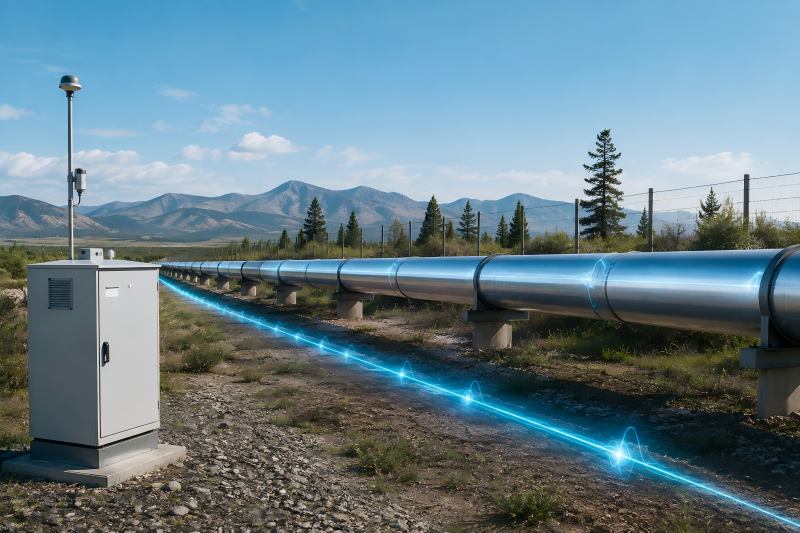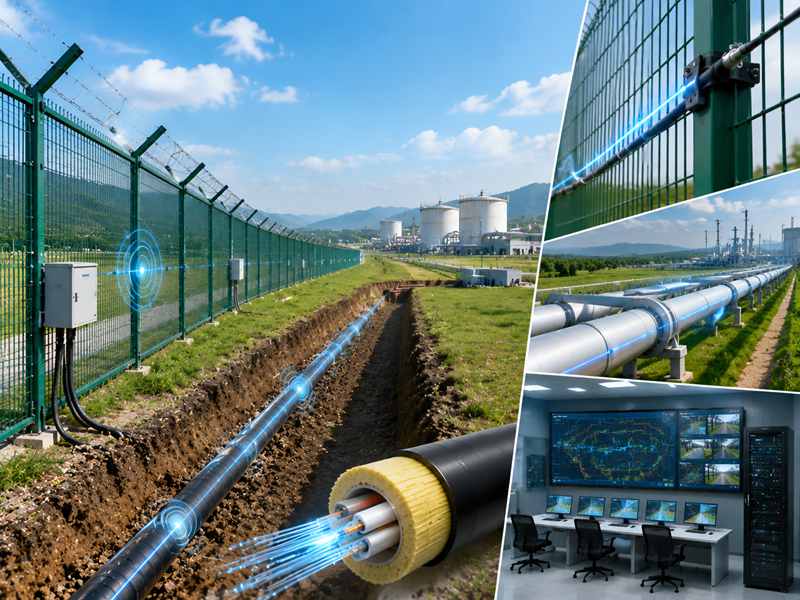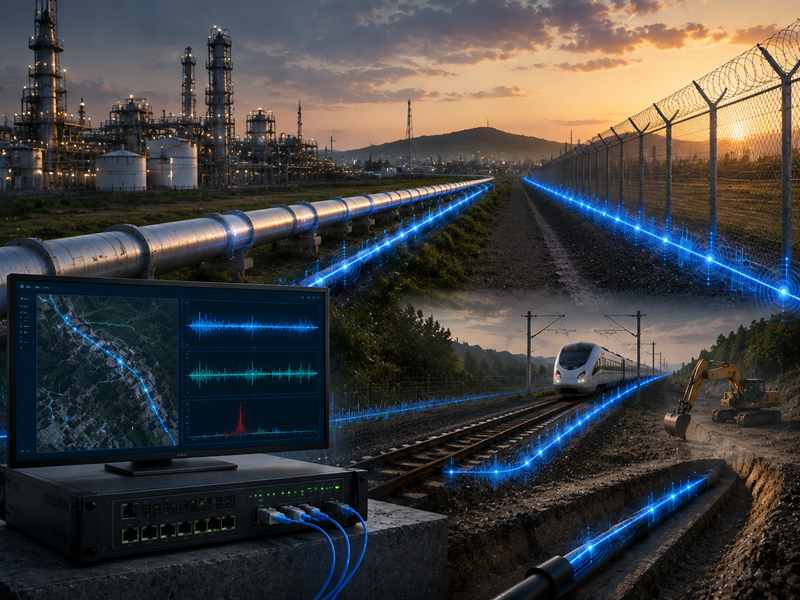
Fiber optic temperature sensors are widely used in power systems, tunnels, pipelines, industrial plants, energy storage, data centers, and hazardous environments. They offer anti-interference performance, long-distance monitoring, passive sensing, and high safety.
Point Fiber Optic Temperature Sensor: What Is It?
A point fiber optic temperature sensor measures temperature at one specific location by detecting optical signal changes. It is commonly used for accurate monitoring in transformers, battery modules, electrical joints, industrial equipment, and high-voltage environments.
Common point fiber optic temperature sensing technologies include:
- Fiber Bragg Grating temperature sensors
- Fluorescence fiber optic temperature sensors
- Fabry-Perot fiber optic temperature sensors
- Fiber tip temperature probes
- Multi-point fiber optic temperature systems
The main feature of point sensors is that they measure temperature only where the sensor is installed. If a hot spot occurs outside the sensor location, the system may not detect it unless another sensor is installed nearby.
Typical Applications of Point Sensors
Point fiber optic temperature sensors are commonly used in:
- Transformer winding temperature monitoring
- Battery module and battery cell temperature monitoring
- High-voltage switchgear monitoring
- Motor and generator temperature monitoring
- Industrial equipment surface temperature measurement
- Laboratory testing and research
- Medical temperature measurement
- Structural health monitoring
- Aerospace and composite material testing
They are particularly helpful when wide-area coverage is not as crucial as measurement accuracy, and the monitoring site is well established.
A Distributed Fiber Optic Temperature Sensor: What Is It?
A distributed fiber optic temperature sensor measures temperature continuously along the entire optical fiber, providing a temperature profile over long distances.
DTS is the most common technology. It uses the fiber itself as the sensing element and analyzes backscattered light to locate temperature changes. It is ideal for power cable tunnels, pipelines, conveyor belts, and utility corridors.
Typical Applications of Distributed Sensors
Distributed fiber optic temperature sensors are commonly used in:
- Power cable temperature monitoring
- Cable tunnel fire detection
- Oil and gas pipeline monitoring
- Conveyor belt fire detection
- Mine tunnel safety monitoring
- District heating pipeline leakage detection
- Energy storage facility temperature monitoring
- Data center cable and busway monitoring
- Railway tunnel and metro tunnel monitoring
- Industrial fire-risk area monitoring
The main advantage of distributed sensing is full-route coverage. It can detect abnormal temperature changes even when the exact hot spot location is unknown.
Basic Comparison: Point vs Distributed Fiber Optic Temperature Sensors
Point and distributed fiber optic temperature sensors are both useful, but they solve different monitoring problems.
| Comparison Item | Point Fiber Optic Temperature Sensor | Distributed Fiber Optic Temperature Sensor |
| Measurement method | Measures specific locations | Measures continuously along the fiber |
| Sensing range | One point or multiple defined points | Entire fiber route |
| Typical output | Temperature value at each sensor point | Temperature profile along distance |
| Best use | Known critical points | Long-distance or large-area monitoring |
| Hot spot detection | Only at installed points | Along the whole monitored route |
| Installation style | Sensor probes or grating points | Sensing cable laid along the asset |
| Main advantage | High accuracy at specific points | Continuous coverage over a long distance |
| Main limitation | May miss events between points | May not provide the same point precision as dedicated probes |
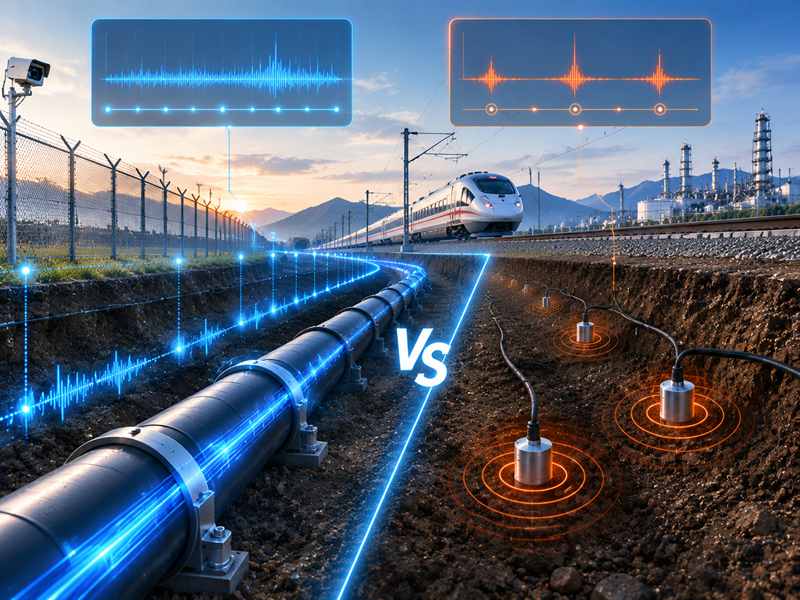
The key difference is simple: point sensors monitor selected positions, while distributed sensors monitor the whole fiber path.
Working Principle Differences
Point fiber optic temperature sensors and distributed fiber optic temperature sensors use different optical principles.
Point sensors usually rely on changes in reflected wavelength, fluorescence decay time, optical phase, or cavity length. The temperature is measured at the sensor head or grating location. Each sensor has a known physical position.
Distributed sensors rely on backscattering along the fiber. The monitoring device analyzes this backscattered signal and calculates the temperature at different points along the fiber.
| Technical Aspect | Point Fiber Optic Sensor | Distributed Fiber Optic Sensor |
| Optical principle | Wavelength shift, fluorescence, or cavity change | Raman, Brillouin, or Rayleigh backscattering |
| Sensing location | Fixed sensor position | Continuous fiber length |
| Data source | Sensor probe or grating | Backscattered optical signal |
| Positioning method | Based on the installed sensor location | Based on the distance along the fiber |
| Measurement form | Single-point or multi-point value | Temperature curve over distance |
| System design focus | Sensor placement accuracy | Fiber route coverage and zone design |
Because of these differences, point sensors are usually better for precise measurement at known locations, while distributed sensors are better for detecting temperature events along long or unknown routes.
Accuracy and Measurement Performance
Point fiber optic temperature sensors usually offer high accuracy because they measure specific, calibrated locations.
Distributed sensors also provide reliable data, but their accuracy depends on cable type, fiber length, resolution, signal quality, and installation. They are suitable for detecting overheating, fire risks, leakage, and abnormal temperature rise.
| Performance Factor | Point Sensor | Distributed Sensor |
| Temperature accuracy | Usually high at the sensor location | Good for route-based monitoring |
| Response time | Fast if the sensor has good thermal contact | Depends on cable structure and installation |
| Spatial resolution | Defined by sensor placement | Defined by system configuration |
| Long-distance monitoring | Limited by the number of sensors | Strong advantage |
| Hot spot detection | Strong at known points | Strong along continuous routes |
| Trend monitoring | Good for selected assets | Good for a complete thermal profile |
For example, if the goal is to measure the temperature of a transformer winding hot spot, a point sensor may be the better choice. If the goal is to detect abnormal heating anywhere along a 5 km cable tunnel, a distributed sensor is more suitable.
Monitoring Distance and Coverage
Monitoring distance is where distributed fiber optic temperature sensors have a clear advantage. A single distributed sensing cable can cover a long route, making it ideal for linear assets.
Point sensors can also be used in long-distance projects, but they only measure at installed positions. To cover a long asset, many sensors may be needed. This increases design complexity, installation time, and cost.
| Monitoring Requirement | Better Choice | Reason |
| Monitor several kilometers of power cable | Distributed sensor | Provides continuous route coverage |
| Measure the temperature inside a transformer | Point sensor | Measures known critical positions |
| Monitor pipeline temperature along the full route | Distributed sensor | Detects abnormal points anywhere along line |
| Monitor battery module points | Point sensor | Compact sensors fit specific locations |
| Detect fire in a tunnel | Distributed sensor | Covers long tunnel sections |
| Monitor motor bearing temperature | Point sensor | Measures specific equipment points |
If the monitoring target is long, continuous, or difficult to inspect manually, distributed sensing is usually more practical. If the monitoring target has only a few important points, point sensing may be more efficient.
Installation Differences
Installation design is another major difference.
Point fiber optic sensors are installed at specific locations. The installer must choose the correct sensor position, ensure good thermal contact, protect the sensor package, and secure the fiber connection. The quality of measurement depends heavily on where the sensor is placed.
The monitored path is equipped with dispersed fiber optic sensors. The sensing cable may be attached to power cables, laid inside cable trays, installed along tunnel walls, fixed to pipelines, or routed around industrial equipment. The quality of route design directly affects monitoring performance.
| Installation Factor | Point Sensor | Distributed Sensor |
| Installation style | Probe, grating, or fixed sensor point | Continuous sensing cable |
| Key design issue | Correct sensor position | Correct cable route |
| Contact requirement | Direct contact at sensor point | Consistent contact along route |
| Number of sensing locations | Limited or predefined | Continuous along fiber |
| Installation complexity | Increases with sensor quantity | Increases with route length and environment |
| Documentation needed | Sensor ID and location | Cable route map and zone division |
For point sensors, a wrong installation position may lead to missing the real hot spot. For distributed sensors, poor cable routing or loose contact may reduce temperature response accuracy.
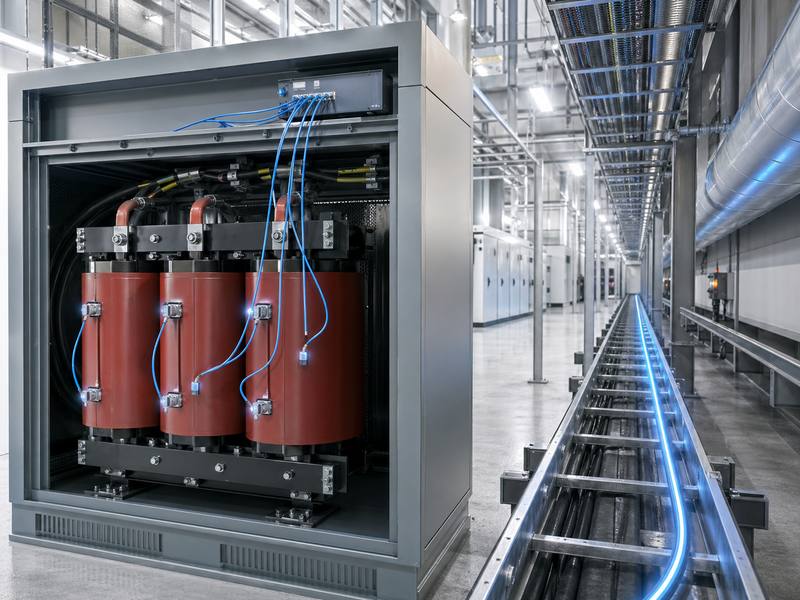
Alarm Logic and Data Visualization
Point and distributed fiber optic temperature sensors use different alarm methods.
Point sensors trigger alarms based on each sensor’s temperature value and location. Distributed sensors support more advanced logic, including absolute temperature, temperature rise rate, zone temperature differences, and hot spot location.
| Alarm Feature | Point Sensor | Distributed Sensor |
| Alarm basis | Individual sensor value | Distance-based temperature profile |
| Alarm location | Sensor ID or equipment point | Distance along fiber route |
| Zone management | Based on sensor groups | Based on route sections |
| Fire detection | Limited to sensor positions | Strong for long linear areas |
| Trend analysis | Point trend curve | Full-route temperature curve |
| Visualization | Sensor list, dashboard, equipment map | Heat map, route map, temperature profile |
Distributed sensing is particularly useful when operators need to know not only that an alarm happened, but also where along the route it happened.
Advantages of Point Fiber Optic Temperature Sensors
Point fiber optic sensors are valuable because they provide accurate and stable data at selected locations. They are particularly useful for temperature monitoring at the equipment level.
Key advantages include:
- High accuracy at specific points
- Compact sensor structure
- Fast response when properly installed
- Suitable for embedded installation
- Good for high-voltage and electromagnetic environments
- Flexible packaging for different applications
- Easy association with specific equipment parts
- Suitable for multi-parameter sensing in some systems
Point sensors are often selected when the project requires reliable temperature data from a known hot spot or critical component.
Example Scenario
In an energy storage system, engineers may need to monitor selected battery modules or busbar connection points. Since the critical positions are known, point fiber optic sensors can provide targeted temperature data and fast warning.
Limitations of Point Fiber Optic Temperature Sensors
Although point sensors are accurate, they have limited coverage. They only measure where they are installed. If a temperature abnormality occurs between sensors, it may not be detected.
Main limitations include:
- Cannot continuously monitor long routes
- May miss unknown hot spots
- Large systems require many sensors
- Sensor placement must be carefully planned
- Installation cost can increase with sensor quantity
- Not ideal for fire detection over large linear areas
For projects where the hot spot location is unpredictable, relying only on point sensors may create blind spots.
Advantages of Distributed Fiber Optic Temperature Sensors
Distributed fiber optic temperature sensors are powerful because they provide continuous monitoring over long distances.
Key advantages include:
- Full-route temperature monitoring
- Long-distance coverage with one sensing cable
- Strong hot spot detection along linear assets
- Suitable for tunnels, pipelines, and cable corridors
- Good for fire detection and early warning
- Clear location information based on distance
- Reduced need for many individual sensors
- Strong anti-electromagnetic interference performance
Distributed sensing is especially valuable in large infrastructure projects where temperature risks may occur anywhere along the monitored route.
Example Scenario
In a power cable tunnel, overheating may occur at joints, bends, overloaded sections, or unexpected locations. A distributed sensor can monitor the full cable route and detect hot spots even if operators did not predict the exact risk position.
Limitations of Distributed Fiber Optic Temperature Sensors
Distributed sensors also have limitations. They may not always provide the same point-level accuracy or response speed as a dedicated point sensor. System cost may also be unnecessary for small projects.
Main limitations include:
- Higher initial device cost
- Performance depends on cable installation quality
- May require professional route design
- Spatial resolution depends on system configuration
- Not always necessary for small point-monitoring applications
- Alarm zones need careful setup to reduce false alarms
Distributed sensing is best when coverage matters more than measuring a few fixed points with very high precision.
Application Comparison
Different applications require different sensing methods. Common use scenarios can be compared using the following table.
| Application | Recommended Sensor Type | Reason |
| Transformer hot spot monitoring | Point sensor | Measures known critical internal or external points |
| Power cable tunnel monitoring | Distributed sensor | Covers long cable routes and detects unknown hot spots |
| Battery module monitoring | Point sensor | Measures selected battery cells, modules, or busbars |
| Oil and gas pipeline monitoring | Distributed sensor | Tracks temperature changes along pipeline routes |
| Conveyor belt fire detection | Distributed sensor | Detects abnormal heat along moving belt systems |
| High-voltage switchgear monitoring | Point sensor | Targets specific contact or joint positions |
| Tunnel fire detection | Distributed sensor | Provides continuous linear fire detection |
| Laboratory temperature testing | Point sensor | Requires accurate measurement at defined positions |
| District heating pipeline leakage | Distributed sensor | Detects abnormal thermal patterns along pipe |
| Motor bearing monitoring | Point sensor | Measures specific mechanical component temperature |
In many industrial projects, the best solution may be a combination of both sensor types.
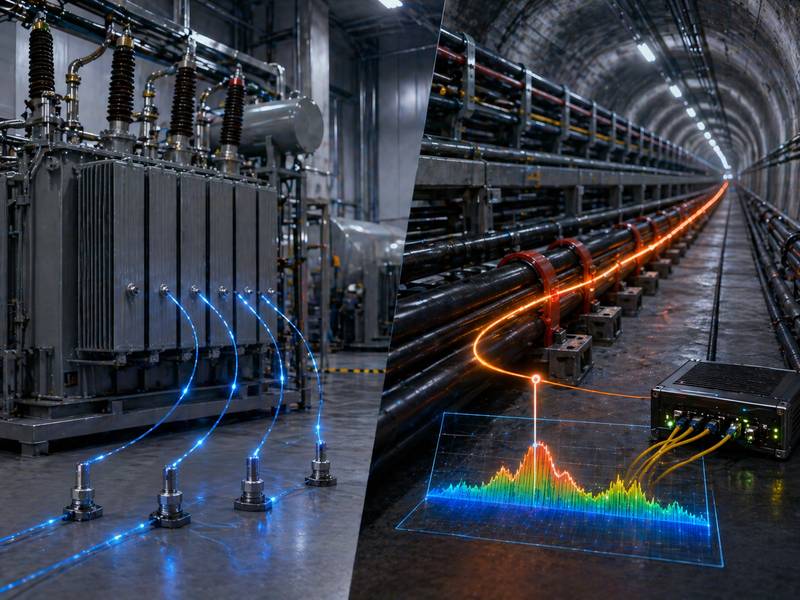
Can Point and Distributed Sensors Be Used Together?
Yes. In some high-value or high-risk projects, point and distributed fiber optic temperature sensors can be combined.
A distributed system can provide wide-area monitoring and detect abnormal temperature changes along the full route. Point sensors can then provide precise data at known critical locations. This hybrid approach is useful when both coverage and accuracy are important.
For example:
- In a substation, distributed sensors can monitor cable tunnels, while point sensors monitor transformers and switchgear.
- In an energy storage facility, distributed sensors can monitor cable trays and fire-risk areas, while point sensors monitor battery modules.
- In an industrial plant, distributed sensors can monitor pipeline routes, while point sensors monitor equipment bearings, tanks, and connection points.
| Hybrid Monitoring Area | Distributed Sensor Role | Point Sensor Role |
| Power facility | Monitor cable routes and tunnels | Monitor transformers and switchgear |
| Energy storage system | Monitor cable trays and room temperature lines | Monitor battery modules and busbars |
| Industrial plant | Monitor pipelines and fire-risk zones | Monitor key machines and process equipment |
| Transportation tunnel | Monitor long tunnel sections | Monitor electrical cabinets and ventilation equipment |
A hybrid system can reduce blind spots and improve alarm reliability.
Selection Guide: How to Choose the Right Sensor
Choosing between point and distributed fiber optic temperature sensors should be based on monitoring goals, asset type, risk location, distance, accuracy requirements, and budget.
Use the following questions during project planning:
- Do you know the exact locations to monitor?
If yes, point sensors may be suitable. - Do you need continuous coverage along a long route?
If yes, distributed sensors are usually better. - Is the hot spot location predictable or unpredictable?
Predictable hot spots favor point sensors. Unpredictable hot spots favor distributed sensors. - Is high point accuracy required?
If yes, point sensors may be preferred. - Is large-area fire or overheating detection required?
If yes, distributed sensors are usually more practical. - How many measurement locations are needed?
A small number of points favors point sensors. A long or complex route favors distributed sensors.
| Project Requirement | Better Choice |
| High-accuracy point measurement | Point sensor |
| Long-distance temperature profile | Distributed sensor |
| Known hot spot monitoring | Point sensor |
| Unknown hot spot detection | Distributed sensor |
| Equipment-level monitoring | Point sensor |
| Infrastructure-level monitoring | Distributed sensor |
| Small project with limited points | Point sensor |
| Large linear project | Distributed sensor |
| Need both coverage and precision | Hybrid system |
Point and distributed fiber optic temperature sensors differ mainly in measurement method. Point sensors monitor specific locations, making them suitable for transformers, batteries, switchgear, motors, and lab equipment.
Distributed sensors monitor continuously along the entire fiber route, making them ideal for cable tunnels, pipelines, conveyor belts, tunnels, and fire-risk areas.
For complex projects, a hybrid system can combine wide-area coverage with accurate point measurement.