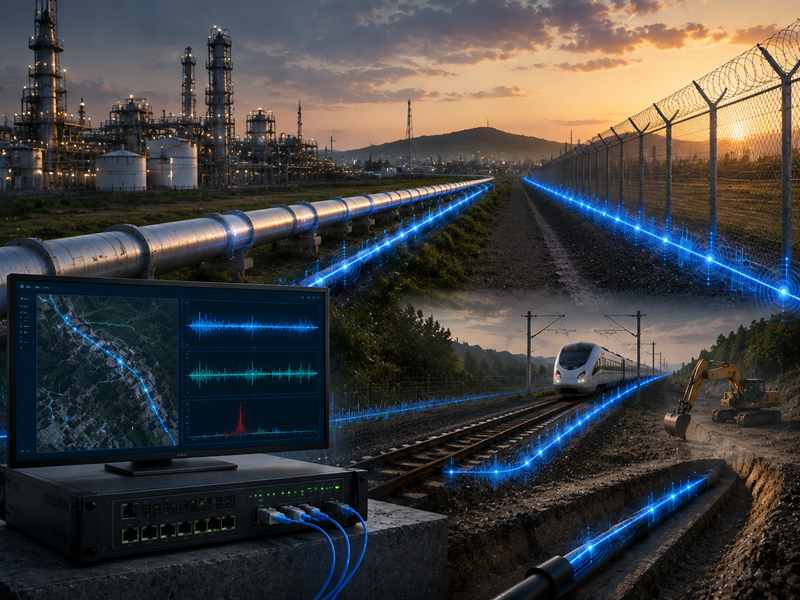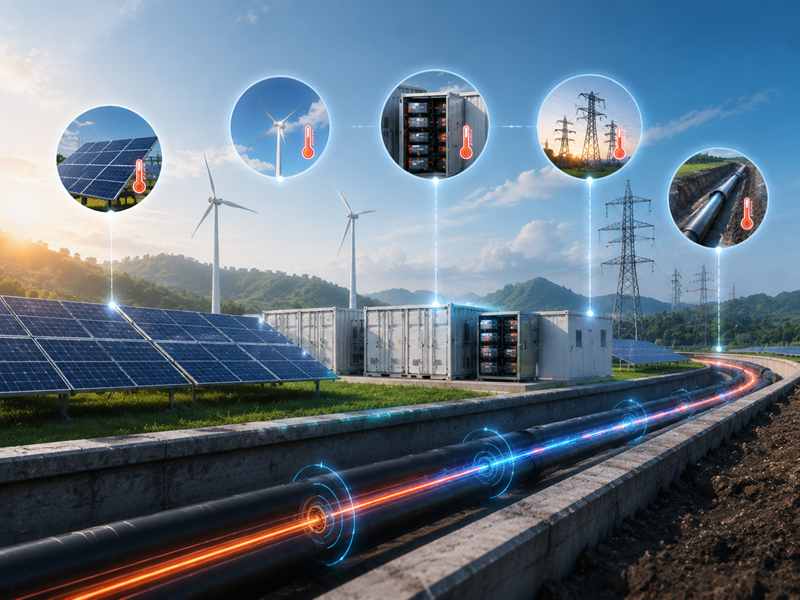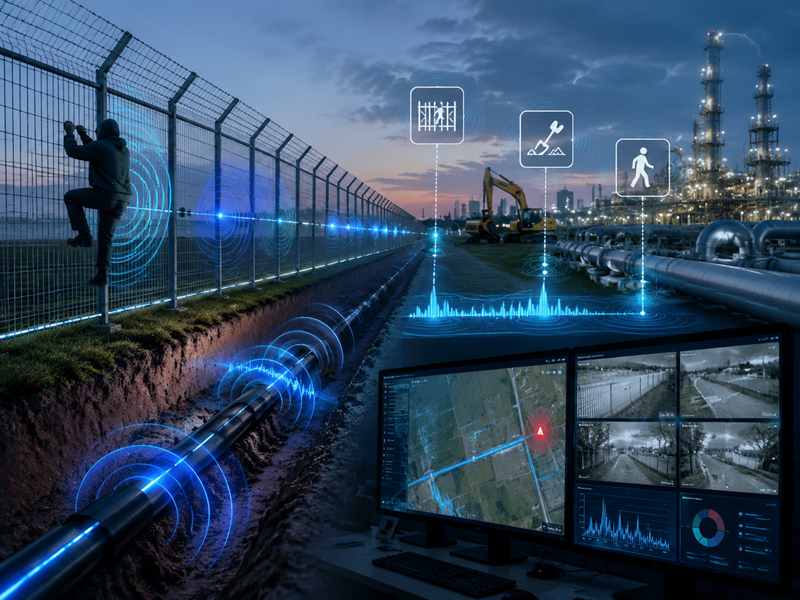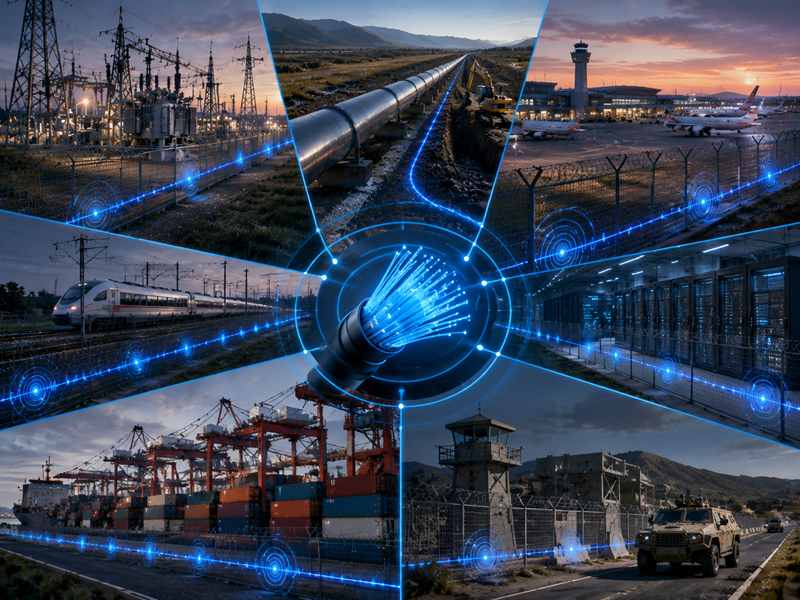
Fiber optic temperature sensors are used in power systems, tunnels, pipelines, industrial plants, energy storage, fire detection, and structural monitoring. They provide long-distance, high-sensitivity, and anti-interference temperature monitoring.
A DTS Fiber Optic Temperature Sensor: What Is It?
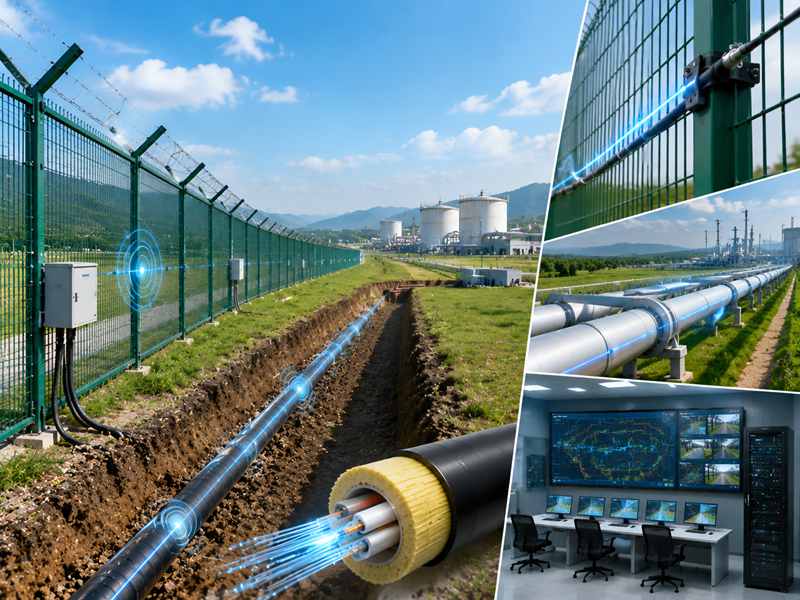
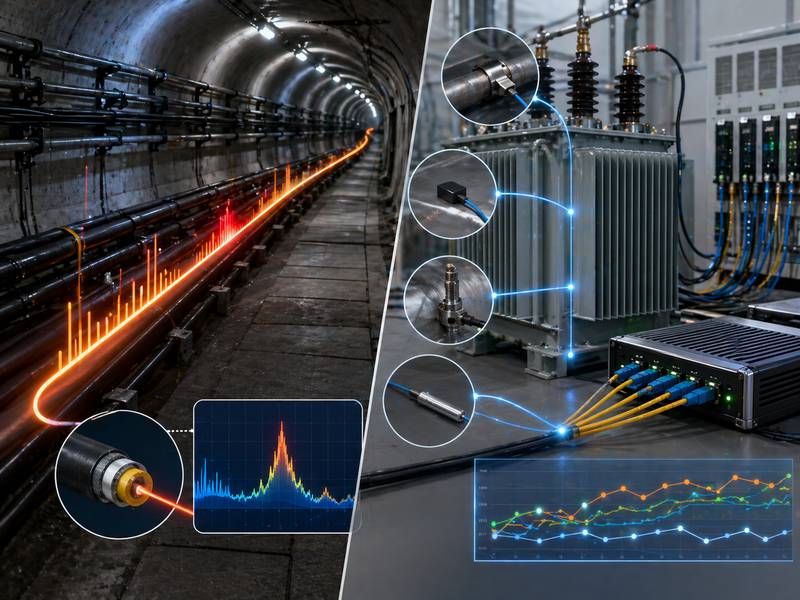
A fiber optic sensing system called Distributed Temperature Sensing, or DTS, continuously measures temperature throughout the length of an optical fiber. In a DTS system, the optical fiber itself functions as a sensing component. Instead of installing many individual point sensors, one fiber cable can monitor temperature changes across hundreds of meters or even several kilometers.
Laser pulses are sent into the cable by the system. As the light travels through the fiber, part of it is scattered back to the monitoring device. By analyzing the backscattered optical signal, the system calculates temperature information along the fiber route. This allows the DTS system to provide a temperature profile of the whole monitored area.
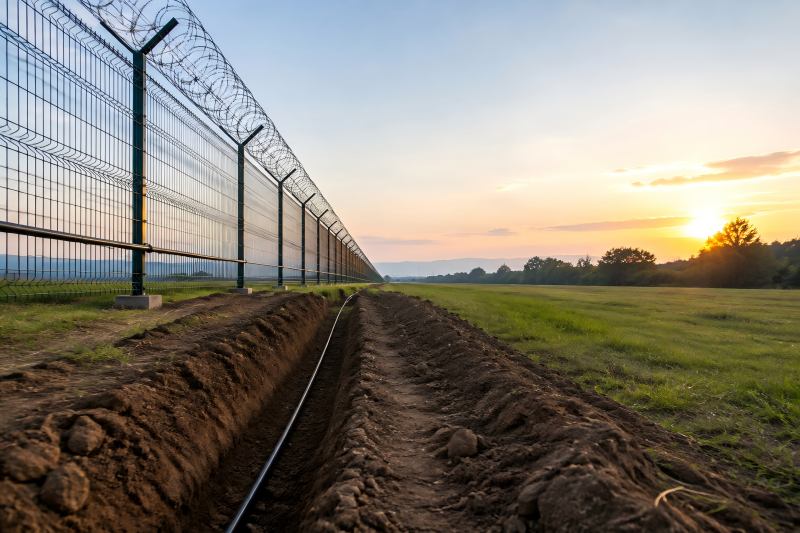
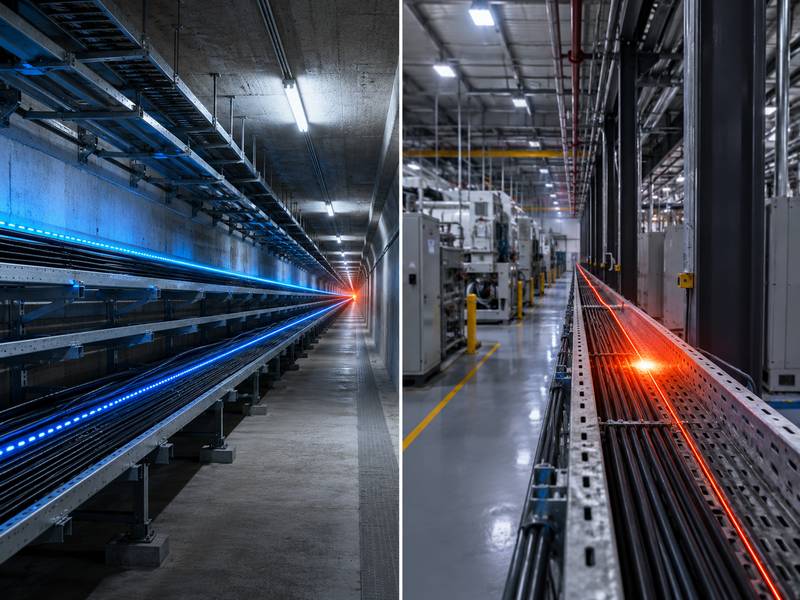
DTS is especially useful when the user needs continuous linear temperature monitoring. For example, in a power cable tunnel, DTS can monitor the temperature distribution along the full cable route. In a pipeline project, DTS can identify abnormal temperature changes along long-distance pipelines. In fire detection applications, DTS can detect hot spots before they develop into serious risks.
Common DTS applications include:
- Power cable temperature monitoring
- Cable tunnel fire detection
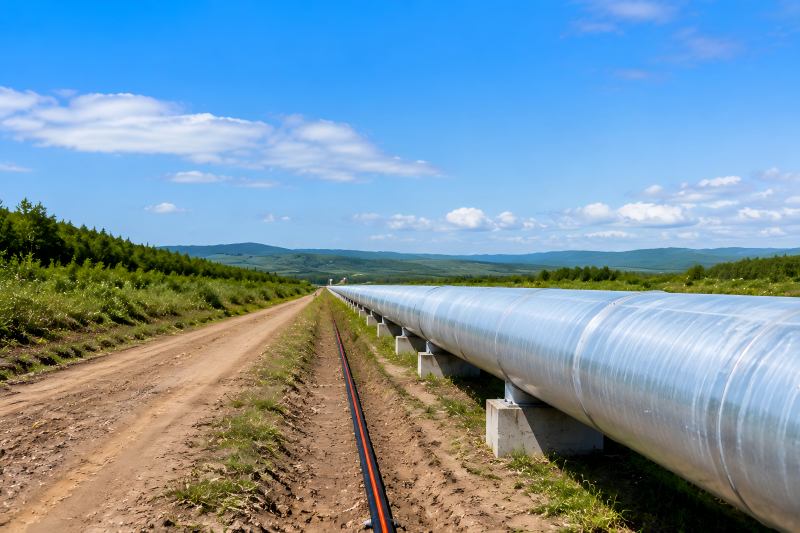
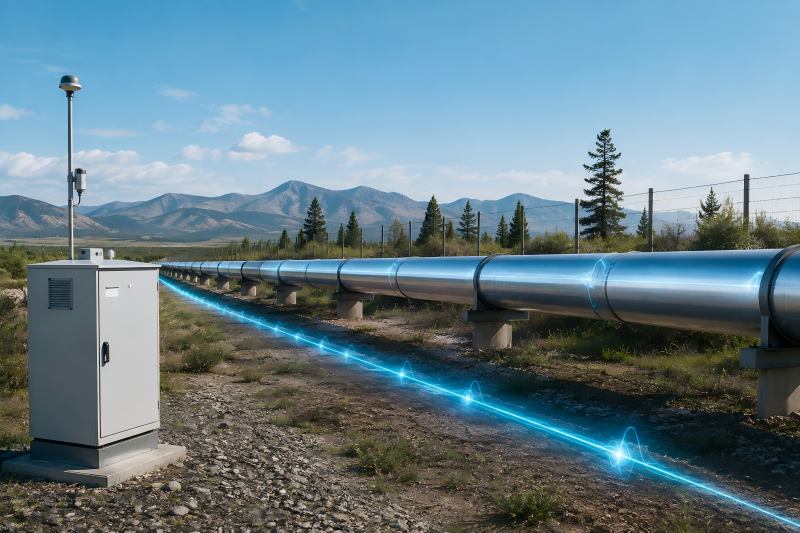
- Oil and gas pipeline monitoring
- Conveyor belt fire detection
- Mine and tunnel safety monitoring
- Energy storage system temperature monitoring
- Industrial plant fire-risk monitoring
- District heating pipeline leakage detection
The biggest advantage of DTS is that it provides distributed measurement. This means users can see temperature changes along the entire fiber, instead of only at selected points.
An FBG Fiber Optic Temperature Sensor: What Is It?
FBG, or Fiber Bragg Grating, is another fiber optic sensing technology. Unlike DTS, which measures temperature continuously along the fiber, FBG sensors measure temperature at specific points where gratings are written into the fiber.
A tiny area inside an optical fiber that reflects a particular wavelength of light is called a fiber bragg grating. The reflected wavelength varies with temperature. By measuring this wavelength shift, the system can calculate the temperature at that specific grating location.
In simple terms, an FBG temperature sensor works like a highly sensitive optical measuring point. Multiple FBG sensors can be written or connected along one fiber, allowing multi-point temperature monitoring.
FBG sensors are often used when high accuracy, fast response, compact size, or precise point measurement is required. They are common in structural health monitoring, transformer temperature monitoring, battery temperature monitoring, composite material testing, aerospace engineering, and laboratory measurement.
Common FBG applications include:
- Transformer winding temperature monitoring
- Battery module temperature monitoring
- Structural health monitoring
- Bridge and tunnel monitoring
- Aerospace and composite material testing
- Industrial equipment temperature measurement
- High-voltage equipment monitoring
- Medical and research applications
The biggest advantage of FBG is precise point measurement. It works well in situations where the user is aware of the precise location where the temperature should be recorded.
DTS vs FBG: Basic Comparison
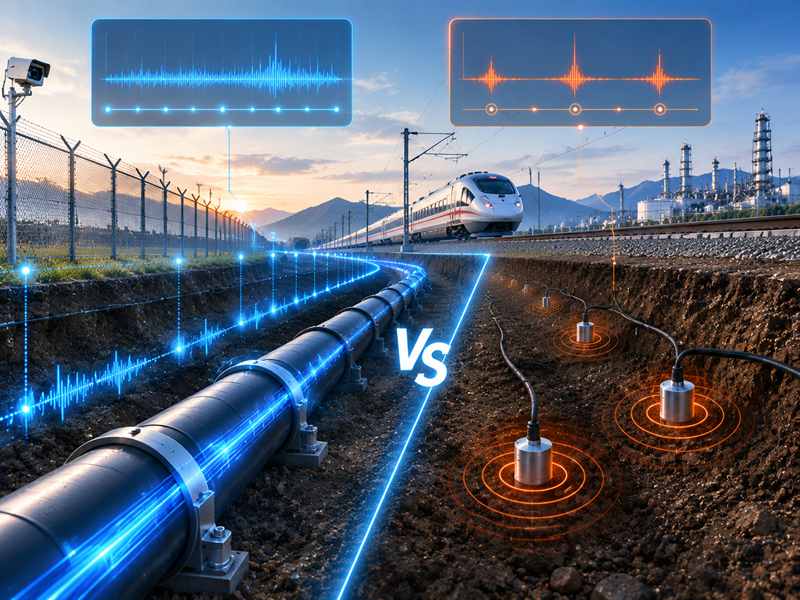
Although both DTS and FBG use optical fiber, they are designed for different monitoring needs. DTS focuses on long-distance distributed measurement, while FBG focuses on precise point or multi-point measurement.
| Item | DTS Fiber Optic Temperature Sensor | FBG Fiber Optic Temperature Sensor |
| Full name | Distributed Temperature Sensing | Fiber Bragg Grating |
| Measurement type | Continuous distributed measurement | Point or multi-point measurement |
| Sensing element | Entire optical fiber | Specific grating points |
| Monitoring distance | Suitable for long distances | Suitable for selected measuring points |
| Data output | Temperature profile along the fiber | Temperature data at each FBG point |
| Typical use | Cable tunnels, pipelines, and fire detection | Transformers, batteries, structures, equipment |
| Main advantage | Large-area continuous monitoring | High precision at defined points |
| System design focus | Route coverage and zone division | Sensor placement and point accuracy |
This comparison shows that DTS and FBG should not always be seen as competitors. In many projects, they solve different problems.
Working Principle Difference
The key difference between DTS and FBG starts with their sensing principle.
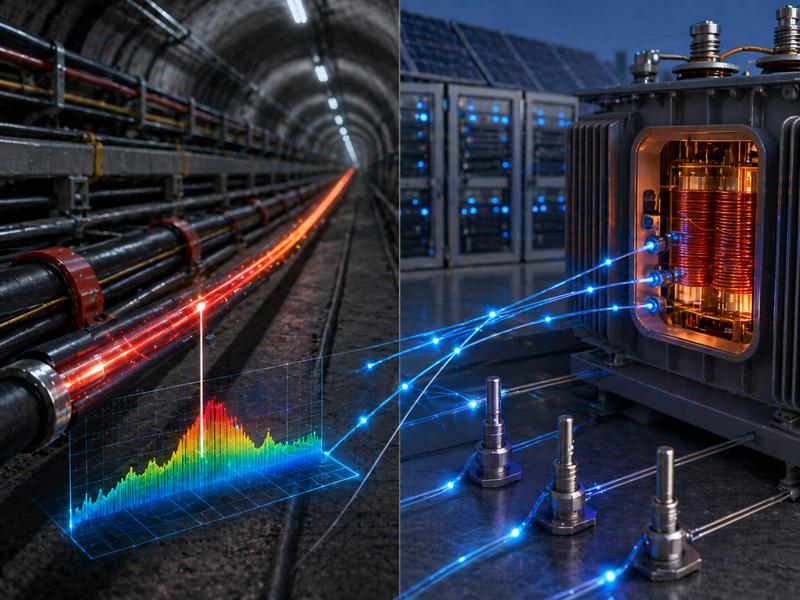
DTS works by analyzing backscattered light along the fiber. Since the system can calculate where the backscattered signal comes from, it can identify temperature changes at different positions along the fiber. The optical fiber acts like a continuous temperature sensor.
FBG works by analyzing the wavelength shift from grating points. Each FBG sensor reflects a specific wavelength. When temperature changes, the grating expands or contracts slightly, causing the reflected wavelength to shift. The monitoring device converts that wavelength shift into temperature data.
| Technical Aspect | DTS | FBG |
| Optical principle | Backscattering analysis | Wavelength reflection shift |
| Measurement location | Along the whole fiber | At grating positions |
| Temperature calculation | Based on the scattered light signal | Based on the Bragg wavelength shift |
| Data density | Continuous or near-continuous | Depends on the number of FBG points |
| Sensor structure | Standard or special sensing fiber cable | Fiber with written grating sensors |
| Positioning method | Based on optical time/location calculation | Based on known sensor positions |
In practical terms, DTS is better when users need to know where along a long route a temperature change occurs. FBG is better when users need to measure specific key points with high accuracy.
5. Monitoring Range and Distance
Monitoring distance is one of the most important differences between DTS and FBG.
DTS systems are designed for long-distance monitoring. Depending on system configuration and fiber type, DTS can monitor hundreds of meters to many kilometers. This makes it suitable for linear assets such as power cables, tunnels, pipelines, and conveyor belts.
FBG systems can also support multiple sensors over one fiber, but the number of points and distance depend on the interrogator, wavelength range, sensor spacing, and system design. FBG is usually more suitable for defined measuring locations rather than continuous long-distance coverage.
| Monitoring Requirement | Better Choice | Reason |
| Several kilometers of cable route | DTS | Continuous monitoring along the full route |
| Pipeline temperature profile | DTS | Detects distributed temperature changes |
| Transformer internal hot spot | FBG | Measures selected critical points accurately |
| Battery module temperature points | FBG | Compact sensors can be placed at key locations |
| Tunnel fire detection line | DTS | Monitors long linear fire-risk areas |
| Equipment surface temperature points | FBG | Provides accurate point-based data |
If the project needs temperature data across an entire route, DTS is usually more practical. If the project needs accurate data from specific locations, FBG is often a better option.
Accuracy and Spatial Resolution
Accuracy and spatial resolution are important, but should not be confused.
The degree to which the measured and real temperatures are similar is referred to as accuracy. Spatial resolution refers to the minimum distance over which the system can distinguish temperature changes.
DTS systems are strong in long-distance coverage, but their spatial resolution and accuracy may vary depending on device performance, fiber length, measurement time, and installation conditions. For many industrial and safety applications, DTS accuracy is sufficient, especially when the goal is to detect hot spots, abnormal temperature rise, or fire risk.
FBG sensors usually provide higher point measurement accuracy because each sensor is a defined optical grating. They can be designed for precise monitoring at critical locations. This makes FBG suitable for applications requiring detailed temperature measurement, such as transformer monitoring, battery testing, and structural monitoring.
| Performance Factor | DTS | FBG |
| Temperature accuracy | Good for industrial monitoring | Usually higher for point measurement |
| Spatial resolution | Depends on system configuration | Defined by sensor placement |
| Response at the exact point | Moderate | Strong |
| Long-distance hot spot detection | Strong | Limited to installed sensor points |
| Measurement repeatability | Good | Very good |
| Best use | Trend and distributed abnormal detection | Precise point measurement |
For example, if a cable tunnel needs to detect any abnormal hot spot along a 5 km route, DTS is more suitable. If a transformer needs accurate temperature measurement at several windings or oil locations, FBG may be more suitable.
Installation and System Layout
DTS installation is usually route-based. The sensing fiber is laid along the monitored asset, such as a power cable, pipeline, tunnel ceiling, or conveyor belt. The quality of cable routing, fixing method, bending radius, and thermal contact has a strong influence on measurement performance.
FBG installation is point-based. Sensors are installed at selected locations where temperature measurement is required. The design focus is not only on fiber routing, but also on sensor placement, packaging, protection, and calibration.
| Installation Factor | DTS | FBG |
| Installation style | Linear cable route | Point sensor placement |
| Design focus | Coverage of the monitored route | Accuracy of selected positions |
| Sensor quantity | One fiber can cover a long distance | Multiple grating points required |
| Installation complexity | Route planning is important | Sensor positioning is important |
| Maintenance focus | Fiber route and connectors | Sensor points and fiber links |
| Best layout | Along cables, pipes, and tunnels | On equipment, structures, batteries |
DTS is usually easier for long-distance coverage because the fiber itself forms the monitoring line. FBG requires a more detailed sensor layout design, but it can provide better data from exact locations.
Data Output and Alarm Logic
DTS and FBG also differ in the way they generate and display temperature data.
DTS provides a continuous temperature profile. Operators can see temperature changes along the fiber route and identify the location of hot spots. Alarm zones can be set by distance, area, risk level, or asset type.
FBG provides temperature data from each sensor point. Alarm logic is usually based on the temperature reading of each grating sensor. This is useful when each measurement point corresponds to a specific asset, such as a transformer winding, battery cell group, bearing, or structural component.
| Data Feature | DTS | FBG |
| Data form | Temperature curve along distance | Temperature value at sensor points |
| Alarm location | Distance-based location | Sensor-point-based location |
| Zone configuration | Very important | Based on sensor grouping |
| Trend analysis | Strong for long routes | Strong for selected points |
| Visualization | Heat map, temperature profile, route map | Sensor list, trend chart, equipment map |
| Alarm logic | Zone alarm, rate-of-rise, differential temperature | Point alarm, threshold alarm, trend alarm |
For fire detection, DTS can identify abnormal heat along a tunnel or conveyor route. For equipment monitoring, FBG can show whether a specific component is overheating.
Environmental Adaptability
Both DTS and FBG sensors inherit many advantages of fiber optic technology. They are passive at the sensing point, resistant to electromagnetic interference, suitable for high-voltage environments, and usable in harsh industrial conditions.
However, their practical adaptability depends on the application.
DTS is often used in environments where long-distance coverage and fire-risk detection are important. The sensing cable can be designed with protective jackets for tunnels, pipelines, cable trays, and outdoor areas.
FBG sensors can be packaged into different structures for specific environments, such as stainless steel probes, surface-mounted sensors, embedded sensors, or miniature sensors. This makes FBG flexible for equipment-level monitoring.
| Environment | DTS Suitability | FBG Suitability |
| High-voltage cable tunnel | Very suitable | Suitable for key points |
| Transformer internal monitoring | Limited | Very suitable |
| Long-distance pipeline | Very suitable | Limited unless points are defined |
| Battery module | Possible but less common | Very suitable |
| Structural monitoring | Possible for the temperature profile | Very suitable for embedded points |
| Industrial fire detection | Very suitable | Suitable for equipment points |
| Laboratory testing | Less common | Very suitable |
DTS is stronger for environmental coverage. FBG is stronger for customized sensor packaging and precise point installation.
Advantages of DTS Temperature Sensors
DTS is preferred when the application requires wide-area, continuous, or long-distance monitoring.
Key advantages of DTS include:
- Continuous temperature monitoring along the whole fiber
- Long-distance coverage with fewer sensing cables
- Good hot spot detection capability
- Suitable for linear assets
- Strong anti-electromagnetic interference performance
- Passive sensing cable, suitable for hazardous areas
- Useful for fire detection and early warning
- Easy visualization of temperature distribution
DTS is especially valuable when the monitored asset is long, continuous, and difficult to inspect manually.
Typical DTS Use Case
A power cable tunnel may run several kilometers underground. Traditional point sensors can only monitor selected locations, which may miss hot spots between sensors. DTS can monitor the whole cable route and identify abnormal temperature rise at specific distances, helping operators find the problem area quickly.
Advantages of FBG Temperature Sensors
FBG is preferred when the application requires high accuracy at specific measuring points.
Key advantages of FBG include:
- High point measurement accuracy
- Compact sensor size
- Fast response depending on packaging
- Multiple sensors can share one fiber
- Suitable for embedded or surface-mounted installation
- Excellent electromagnetic interference resistance
- Good for equipment condition monitoring
- Can measure temperature together with strain in some systems
FBG is especially valuable when the user knows the critical points that need monitoring.
Typical FBG Use Case
In a transformer, the temperature at certain internal or external locations is more important than the temperature along a long route. FBG sensors can be installed at selected hot spot areas to provide accurate real-time data, helping operators evaluate equipment condition and prevent overheating.
Limitations of DTS and FBG
No sensing technology is perfect. Both DTS and FBG have limitations.
| Technology | Main Limitations |
| DTS | May have lower point accuracy than FBG; performance depends on fiber length, measurement time, and installation quality; may be unnecessary for small point-monitoring projects |
| FBG | Only measures at installed grating points; may miss temperature events between sensors; large numbers of sensors can increase design and installation cost |
DTS is not always the best option when only a few precise measurement points are needed. FBG is not always the best option when the user needs continuous monitoring along long distances.
How to Pick Between FBG and DTS
The ideal option will depend on what you wish to keep an eye on.
Choose DTS if your project needs:
- Long-distance temperature monitoring
- Continuous temperature profile
- Hot spot detection along a cable, tunnel, or pipeline
- Fire detection over large linear areas
- Zone-based alarm management
- Fewer sensing cables for wide coverage
Choose FBG if your project needs:
- Accurate measurement at specific points
- Compact sensor installation
- Equipment-level temperature monitoring
- Embedded temperature sensing
- Multi-point monitoring over selected locations
- Temperature and strain monitoring in one system
| Project Requirement | Recommended Technology |
| Monitor the full cable route | DTS |
| Detect hot spots in the tunnel | DTS |
| Monitor pipeline leakage or abnormal heat | DTS |
| Measure transformer hot spots | FBG |
| Monitor battery pack temperature points | FBG |
| Measure temperature in composite structures | FBG |
| Monitor many unknown hot spot locations | DTS |
| Monitor known critical points | FBG |
In some advanced projects, DTS and FBG can also be combined. DTS provides wide-area monitoring, while FBG provides precise measurement at critical points. This hybrid solution can offer both coverage and accuracy.
DTS vs FBG: Summary Table
| Comparison Item | DTS | FBG |
| Measurement concept | Distributed sensing | Point sensing |
| Sensing range | Entire fiber route | Selected grating points |
| Best for | Long-distance assets | Critical measurement points |
| Main strength | Continuous coverage | High point accuracy |
| Alarm type | Distance-based and zone-based | Sensor-point-based |
| Installation | Along the monitored route | At specific locations |
| Data display | Temperature profile | Point temperature trend |
| Cost advantage | Large-scale monitoring | Limited-point monitoring |
| Typical industry | Power, tunnel, pipeline, and fire safety | Power equipment, battery, structure, aerospace |
| Limitation | Less suitable for small point projects | Cannot monitor between sensor points |
DTS and FBG are used for different temperature monitoring needs. DTS monitors the entire fiber route, making it ideal for long-distance and wide-area applications. FBG measures temperature at specific points, making it suitable for critical equipment and components.
Simply put, DTS is better for full coverage, while FBG is better for precise point monitoring.