
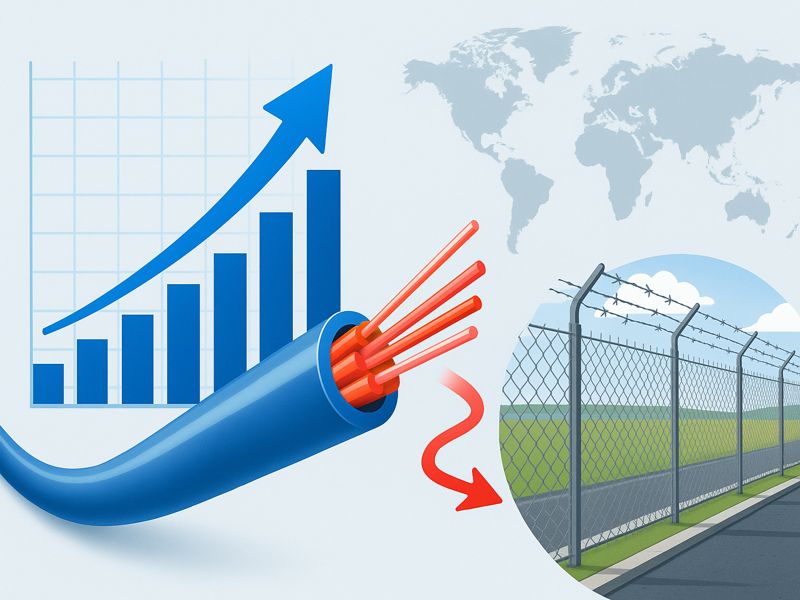
Global Market Trends in Fiber Optic Intrusion Detection Systems
FOIDS use optical fibers as continuous sensors to detect and classify disturbances across perimeters, buried lines, and linear assets. Adoption has surged recently due to growing infrastructure threats, maturing DAS technology, stricter monitoring regulations, and lower lifetime costs. The broader DAS market—valued at ~$0.6–0.8B in 2023–2025—is expanding steadily with strong growth projected through 2030. Meanwhile, dedicated estimates for fiber-optic perimeter intrusion solutions point to a smaller but briskly growing sub-segment, supported by fence-, wall-top-, and buried-cable deployments at high-security sites. What’s Driving Demand 1) Critical Infrastructure And Linear Assets Pipeline operators, railways, and utilities are turning to FOIDS/DAS to detect third-party interference (TPI), leaks, ground movement, theft/tamper events, or animal/human intrusions—use cases where continuous coverage and pinpoint localization matter more than adding more discrete sensors. This “continuous sensing” value proposition strongly differentiates fiber from legacy point sensors. 2) Lower Total Cost Over Distance When protecting tens to hundreds of kilometers, FOIDS often beats traditional sensors on cost per kilometer because a single interrogator channel can cover long runs (dozens of km) with precise localization. System examples publicly cite long-range coverage and multi-topology mounting (fence, buried, wall-top). 3) Analytics, Ai/Ml, And Fewer Nuisance Alarms Modern classifiers trained on vibration signatures reduce nuisance alarms from wind, rain, or vehicles, while enabling event labeling (cut vs climb vs dig). Railway research highlights ML-based intrusion classification to improve safety outcomes and response speed, reflecting a wider market shift to analytics-first FOIDS. 4) Compliance and Insurer Expectations Security standards for energy, transportation, and data-center perimeters are pushing continuous monitoring and tamper-evident controls, nudging buyers toward technologies that document detection performance and service levels—an area where FOIDS/DAS data logs and auditability are compelling. Market Sizing Context: FOIDS within the DAS Universe Most published market numbers track DAS, the core technology behind many FOIDS. Representative analyst cuts include: Grand View Research: global DAS valued $627.9M (2023), CAGR ~10.9% (2024–2030). Mordor Intelligence: DAS $0.77B (2025), to $1.12B (2030) at ~8.2% CAGR Global Market Insights: DAS $635M (2023), >9.5% CAGR (2024–2032). Segment-level reports aimed specifically at fiber-optic perimeter intrusion show a smaller, security-focused market with steady growth into the 2030s. Treat these as directional (methods vary), but they align with the broader DAS growth story. Technology Trends Redefining FOIDS A) From Hardware-Centric To Analytics-Centric Next-gen interrogators still matter (dynamic range, channel count, sampling rate), but buyers are increasingly choosing platforms—where detection performance comes from signal processing and AI/ML models tuned to the environment (fence fabric, soil type, traffic pattern). Vendors emphasize adaptive algorithms to maintain probability of detection (Pd) while suppressing nuisance alarms. B) Multi-Topology Flexibility Best-of-breed systems support fence-mounted, buried, and wall-top modes on the same platform, reducing SKU sprawl and simplifying lifecycle management. This flexibility helps integrators standardize across sites. C) Open Integration With Psim/Vms And Soar FOIDS data is most valuable when fused with video, access control, and radar. Open APIs and certified integrations with VMS/PSIM platforms are now table-stakes, driving faster operator response and enabling alarm-to-video verification workflows—another lever against nuisance alarms. D) Edge + Cloud Architectures Edge inference minimizes latency and bandwidth, while cloud analytics enable fleet learning across sites (e.g., recognizing a new dig signature). Expect hybrid deployments where sensitive raw acoustic data stays local, but metadata and models sync centrally. E) Cyber-Hardening Of Physical Security Systems As FOIDS joins IT/OT networks, buyers demand secure-by-design devices (signed firmware, role-based access, encrypted comms) and secure remote service. This trend mirrors CIS benchmarks in OT and aligns with zero-trust programs in critical infrastructure. Adoption Patterns By Vertical Vertical Primary FOIDS Roles Notes Oil & Gas (midstream, terminals) Third-party interference, digging, leak/flow anomaly adjunct, perimeter cut/climb DAS widely used along pipelines; FOIDS complements SCADA & pigging. Congruence Market Insights+1 Rail & Transit Intrusion (trespass, animals), rockfall/landslide detection near rights-of-way ML-assisted classification reducing false trips; supports safety KPIs. MDPI+1 Power & Utilities Substation fence protection, cable tunnels, right-of-way monitoring ADSS fiber paths can carry sensing; PSIM/VMS integration is common. Global Market Insights Inc. Data Centers Fence/wall-top detection with video verification FOIDS adopted for large campuses with long perimeters. Airports & Ports Fence/ground intrusion, shoreline or fence-line tapping Environmental noise demands robust analytics; integration with radar. Correctional & Defense High-security perimeters, buried detection zones Long-range localization beneficial for response playbooks. Regional Outlook North America: Mature adopter base in energy, utilities, and data-center campuses. Growth tied to grid modernization, pipeline TPI mitigation, and federal critical-infrastructure guidance. DAS market momentum corroborates steady spend. Europe: Demand driven by rail modernization and critical infrastructure mandates. Environmental noise sensitivity and privacy regulation elevate the value of non-imaging, privacy-preserving sensing like FOIDS. Middle East: Above-average adoption for oil & gas and large industrial perimeters; long linear assets make FOIDS’ economics attractive. Asia-Pacific: Fastest relative growth—railway expansion, ports, airports, and new energy corridors. Research output around railway intrusion monitoring indicates active innovation and pilots turning into programs. Latin America & Africa: Select deployments around mining, pipelines, and national energy assets; projects often tied to public–private security programs. Competitive Landscape: Convergence and Specialization The supplier map includes specialist FOIDS vendors and broader perimeter-security companies integrating fiber into multi-sensor platforms: Specialist fiber-optic security: Future Fibre Technologies (FFT), Fiber SenSys (FSI), Senstar (FiberPatrol) are visible in reference deployments and product collateral, with fence, wall-top, and buried solutions. DAS ecosystem: A wider field provides interrogators and analytics spanning security and industrial monitoring; overall market health here is a bellwether for FOIDS. What buyers will notice: vendors differentiating on (1) algorithmic performance in noisy environments; (2) integration depth with VMS/PSIM; (3) ease of tuning/commissioning; (4) multi-topology support; and (5) lifecycle services. Procurement And Deployment Trends 1) Performance Guarantees & Outcome-Based SLAs Instead of box-spec comparisons, large buyers are requesting site-specific acceptance tests (Pd, FAR/NAR, localization accuracy, environmental robustness) and service SLAs (response, retraining models, firmware cadence). 2) Proof-of-Value Pilots With ClearKPIs Common KPIs: detection probability for defined threats (cut, climb, dig), localization error (± meters), mean time to detect (MTTD), and false/nuisance rates under wind/rain. Multi-week pilots across day/night and weather regimes are becoming standard. 3) Lifecycle Attention: Trenching