
Airport runways face extreme loads and environmental stress, making accurate temperature monitoring essential for safety and performance. This article explores how fiber optic temperature sensing enables reliable, high-resolution runway monitoring and its advantages over traditional methods.
Why Temperature Monitoring Matters for Airport Runways
Runway integrity and performance depend heavily on temperature-dependent physical processes. Elevated or fluctuating temperatures can:
- Accelerate pavement degradation: Asphalt layers soften at high temperatures, while thermal contraction at low temperatures can lead to cracking and surface irregularities.
- Alter load-bearing characteristics: Subsurface temperature changes impact stiffness and modulus of pavement materials, affecting load distribution.
- Influence maintenance and safety operations: Real-time temperature data can inform decisions about runway usage, de-icing operations, and aircraft braking performance.
Listening only to discrete thermocouples or surface probes has limitations in coverage and granularity. Runways, especially long ones exceeding a mile in length, benefit from continuous, distributed temperature data rather than isolated point measurements.
How Fiber Optic Temperature Sensing Works
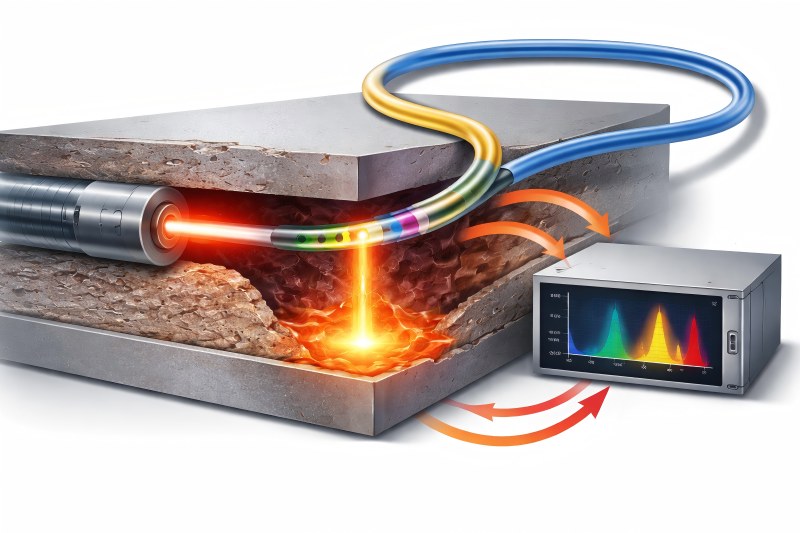
A fiber optic temperature sensor uses optical fibers as the sensing medium, replacing traditional electrical sensors. Light pulses transmitted through an optical fiber experience changes due to temperature variations along the fiber. These changes are then detected and interpreted by a dedicated interrogation system to produce a temperature profile.
Core Principles
There are two major distributed sensing approaches used for temperature monitoring in infrastructures like airport runways:
Distributed Temperature Sensing (DTS)
In this method, the optical fiber itself acts as a continuous sensor covering long distances. Light is sent through the fiber and the fraction of backscattered light — typically based on Raman scattering — is analyzed to determine local temperature along the fiber’s length. Spatial resolution scales from meters to dozens of kilometers depending on system configuration.
Fiber Bragg Grating (FBG) Sensors
FBGs are inscribed along the fiber at specific intervals. They reflect particular wavelengths of light, and shifts in the reflected wavelength correspond to temperature changes at precise locations. This allows discrete multipoint temperature sensing with high precision.
Key Advantages of Fiber Optic Sensors:
| Feature | Benefit |
| Distributed measurement | Continuous temperature data along kilometers of runway |
| High spatial resolution | Detect small thermal anomalies or gradients |
| EMI immunity | Not affected by electromagnetic interference |
| Durability and flexibility | Withstand harsh environmental conditions |
| Non-conductive and safe | Ideal for critical infrastructure |
Installing Fiber Optic Sensors in Runways
Integrating fiber optic temperature sensing in runway systems involves embedding or laying fiber optic cables within and beneath the pavement layers. These installations can be configured as:
- Subsurface installations: Fiber routes run within the base and sub-base layers of runways to capture temperature variations affecting structural components.
- Surface or near-surface configurations: Suitable for monitoring surface thermal gradients that influence friction and material performance.
The placement design depends on specific monitoring objectives — such as detecting hotspots (zones of excessive heat), monitoring freeze-thaw effects, or managing thermal effects from aircraft landing cycles.
Typical Fiber Deployment Zones and Monitoring Goals
| Deployment Zone | Monitoring Objective | Examples of Insights |
| Runway surface layers | Surface temperature mapping | Detect high heat zones; friction performance correlation |
| Base and sub-base | Subsurface thermal behavior | Detect thermal gradients affecting pavement stiffness |
| Adjacent taxiways | Cross-infrastructure thermal linkage | Early warning for edge cracking |
| Complete runway length DTS | Continuous profile | Identify systemic thermal trends |
Technical Considerations for Runway Applications
Fiber optic sensors have several technical characteristics that make them ideal for runway monitoring, but they also require careful system design and calibration.
Resolution & Accuracy
Distributed fiber optic systems can achieve meter-level spatial resolution and temperature resolution within ±1°C or better, allowing detailed thermal characterization of multiple runway zones.
Calibration Challenges
Accurate runway temperature sensing requires careful calibration to differentiate between true thermal changes and factors like fiber strain or installation stresses. Calibration routines often involve reference temperature sources and baseline profiling.
Environmental Robustness
Optical fibers — typically made of glass — are inherently resistant to corrosion, chemical attack, and electromagnetic fields. This makes them suitable for the harsh airport environment, where electrical sensors can suffer from EMI and corrosion.
Comparing Fiber Optic Sensors to Traditional Methods
To understand the transformative value of fiber optic sensors in airport runway monitoring, it’s helpful to compare them with conventional technologies like thermocouples or infrared surface scanners.
Fiber Optic vs Traditional Temperature Sensors
| Metric | Traditional Sensors (Thermocouples) | Fiber Optic Sensors |
| Measurement type | Point-based | Distributed profile |
| Installation complexity | Moderate | Moderate-high initial setup |
| Spatial coverage | Limited | Full runway length |
| Maintenance | Requires regular checks | Robust long-term sensor integrity |
| EMI susceptibility | High | None |
| Environmental durability | Susceptible | Highly resistant |
| Data richness | Low | Very high |
Summary: While traditional sensors remain valuable for localized temperature measurements, they struggle to deliver a complete picture along long, complex infrastructures like airport runways. Fiber optics provides continuous data streams that help engineers and airport operators make better maintenance and safety decisions.
Use Cases and Real-World Examples
Structural Health Monitoring
Distributed fiber optic temperature sensors create a thermal “map” of runway conditions. By correlating temperature variations with structural responses and stress patterns, engineers can anticipate pavement distress before visible damage occurs.
Operational Safety
Temperature data helps airports manage operations, especially in extreme weather. For instance:
- Hot weather runway maintenance: Detect surface softening to schedule early maintenance.
- Cold weather operations: Identify subsurface freeze zones that affect braking performance.
Data-Driven Predictive Maintenance
Continuous temperature monitoring supports predictive models that forecast wear and failure, enabling targeted maintenance planning that extends runway life and reduces unplanned closures.
Smart Runway Integration
Airport digital runway concepts use fiber optic sensors alongside other IoT technologies to create an intelligent monitoring system. This aligns with research into “smart runways” that integrate multi-sensor data for real-time performance assessment.
Benefits of Fiber Optic Temperature Monitoring in Airports
Using fiber optic sensors in runway monitoring brings several operational, safety, and financial advantages:
Enhanced Safety
Continuous real-time temperature data lets airport authorities react quickly to thermal anomalies that may affect runway friction, pavement integrity, or load-bearing capacity.
Lower Long-Term Costs
Although initial installation may be costlier than traditional sensors, fiber optic systems reduce long-term maintenance expenses by providing early warnings that prevent major repairs.
Scalability
Fiber networks can be extended or upgraded with new sensing modalities without significant structural changes — an essential feature for expanding airport facilities.
Challenges and Future Trends
Despite their many advantages, fiber optic temperature sensors in runway applications face a few challenges:
- Complexity of data interpretation: The huge volume of continuous temperature data requires sophisticated analytics and sometimes machine learning to extract actionable insights.
- Installation and calibration: Proper embedding and baseline calibration are technically demanding.
- Integration with legacy systems: Airports often need to merge fiber sensor data with existing maintenance and safety platforms.
However, research trends point toward ever-more capable systems with improved resolution, integrated multiparameter sensing (temperature and strain), and tighter integration with digital runway management platforms — all part of the evolution toward smarter and safer airport infrastructure. Integrated fiber sensor networks have been studied for large structural health monitoring, including runways, highlighting the potential for wide-area, real-time operational data.
Airport runways endure extreme loads and conditions, making precise temperature monitoring critical. This article explains how fiber optic sensing enables reliable, high-resolution runway monitoring.