
Buried Cable Intrusion Detection System

Buried Cable Intrusion Detection System

Buried Cable Intrusion Detection System Component

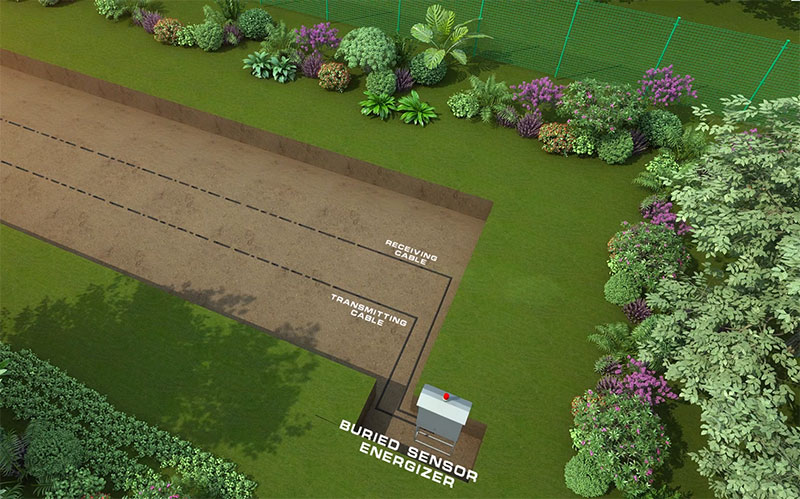
Buried sensing cables create an invisible detection field when installed underground or inside walls. When the system detects activity consistent with an intrusion, the control unit triggers an alarm while filtering out common sources of environmental interference.

Component For Buried Cable Intrusion Detection System
Buried Sensor Energizer

Embedded Medium For Install

Sandy Soil

Sandy Soil

The soil is loose but has low compaction. A burial depth of 30-40 cm is required for effective detection and the cable needs to be protected by a casing to prevent erosion and displacement.

Clay Soil

Clay Soil

Dense and compact, suitable for vibration sensitive detection. Need to be buried 40-50 cm deep, avoid pressure when placed to ensure stability and correct signal transmission.

Loam Soil

Loam Soil

Provides a balance of stability and compaction. Can be installed at a depth of 40-50 cm to ensure safe placement, but requires proper drainage to avoid moisture damage over time.

Rocky or Gravelly Soil

Rocky or Gravelly Soil

Need to be buried 50-60 cm to prevent movement or exposure. Additional protective sleeves are required to avoid rock damage, and careful planning and safe placement are required.

Peat or Wet Soil

Peat or Wet Soil

Will retain some moisture, 30-50 cm depth is feasible, moisture-proof materials can be used to protect the cable and stabilize the soil to prevent erosion and damage.

Silty Soil

Silty Soil

Smooth, but may erode. Should be buried 40-50 cm deep to ensure stability. Ensure good drainage and secure cables to avoid movement or damage.

Prevent Intrusions Types

Vehicle and Intruder Movement

Vehicle and Intruder Movement

The movement of vehicles or intruders entering the electromagnetic field space can be detected, providing early warning of intrusion.

Digging or Tunneling

Digging or Tunneling

The system detects unusual disturbances or digging movements nearby that can signal an attempt to tunnel or dig under a fence or barrier.

Climbing or Damaging Fences

Climbing or Damaging Fences

The disturbance caused by an intruder attempting to climb over or damage a fence can be detected, especially when combined with nearby movement.

Vandalism or Deliberate Sabotage

Vandalism or Deliberate Sabotage

Sabotage, such as attempts to cut or damage a sensor cable, can trigger an alarm if the system detects tampering with the cable itself.

Featured Products

Application Scenarios

Hermitage

Provides secure perimeter protection for heritage areas, with underground cables that preserve landscape integrity and cultural building appearance, while monitoring activities and issuing timely alarms.

Electromagnetic sensor wires, which can adapt to a variety of situations and terrains, increase the level of security. They maintain high detection accuracy even in harsh weather conditions, ensuring internal order and stability.

Discreet perimeter protection for energy facilities is provided by electromagnetic sensing cables, which successfully identify entry attempts and integrate with current monitoring systems to guarantee the facilities’ safe operation.

The villa estate ensures intelligent security management with underground-buried electromagnetic sensing cables that monitor approaching behavior near the boundary while preserving aesthetics, offering enhanced security for the owner.

Hermitage
Regulatory Venue
Energy Facilities
Villas and estates

Frequently Asked Questions

How sensitive are the buried sensors?

Answer: Buried sensors are highly sensitive and can detect even small disturbances such as footsteps or light digging. Sensitivity levels can be adjusted to reduce false alarms from environmental factors like animals or weather, ensuring the system responds only to genuine threats.

Answer: Yes, buried sensors are highly resistant to tampering because they are installed underground, making them difficult for intruders to locate or disable. Any attempt to dig or disturb the sensor cables will trigger an alert, providing early detection of tampering.

Answer: Rain, snow, and extremely high or low temperatures are just a few of the weather situations under which buried sensors are intended to function dependably. The cables are sealed to protect against moisture and environmental wear, ensuring reliable performance year-round.

Answer: Yes, buried sensors can detect animal movement, especially larger animals like deer, dogs, or livestock. However, the system can be adjusted to reduce false alarms from smaller animals such as rodents, ensuring that only significant disturbances trigger alerts.

Answer: Indeed, it is possible to easily combine buried sensors with other security systems including alarm, access control, and video surveillance. Coordination of responses to identified intrusions is made possible by integration, which offers a unified approach to security.

Answer: Once installed, buried sensors require minimal maintenance. To make sure the system is properly calibrated and operating at its best, routine inspections can be required. Repairs are typically only needed if there is physical damage to the cables or sensors, such as from digging or erosion.

Answer: Yes, buried sensors are highly effective at detecting digging or tunneling attempts along the perimeter. The sensors detect the vibrations or pressure changes caused by such activities and can alert security teams before the intruder completes the breach.

Answer: Yes, buried sensors are ideal for securing large areas, such as borders, pipelines, or expansive properties. They can be scaled to cover vast perimeters and are highly effective in remote or hard-to-reach locations where traditional security measures may not be feasible.

How Can We Help?

Select your request type and provide a few details. We’ll direct your inquiry to the appropriate Gato Security team.

    Product video